
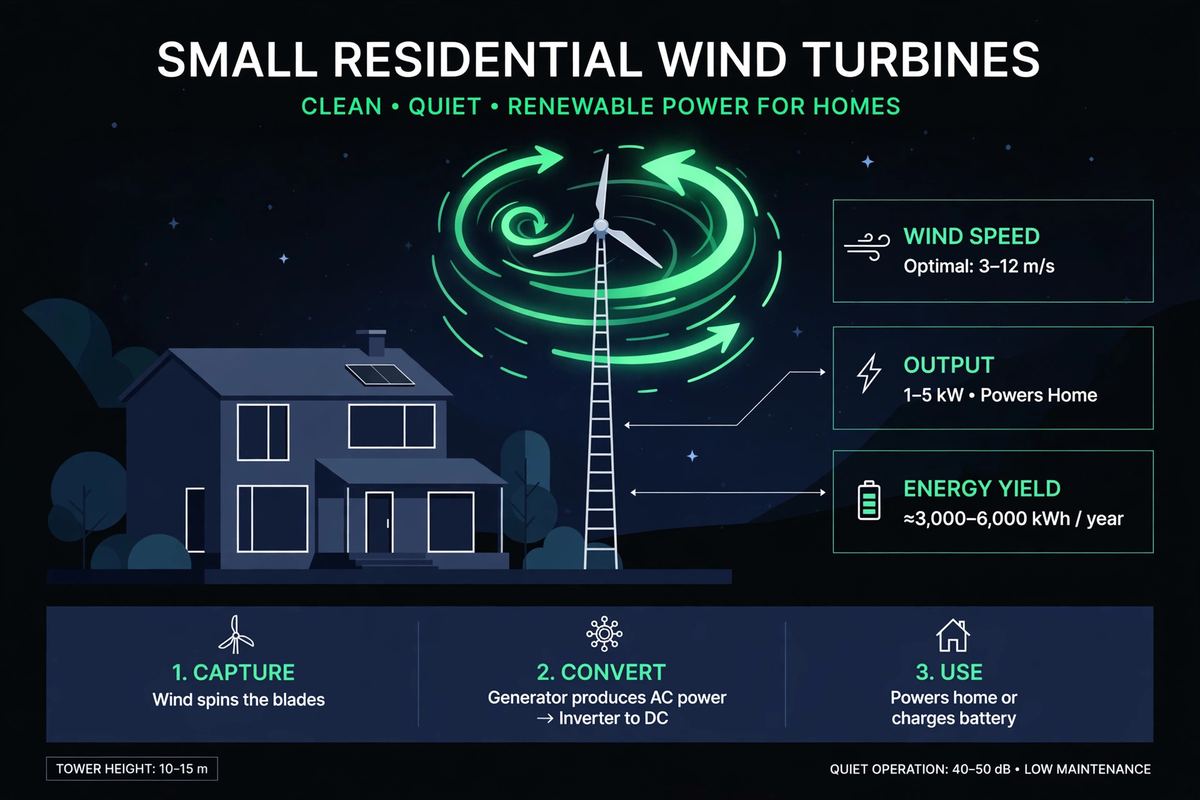
- A veteran turbine builder documented a 12-foot machine rated at 4,316 kWh per year delivering only about 2,800 kWh in the real world, a 35 percent shortfall he says repeats across the industry.
- Our calculation: an 8.9 kW home turbine costing about $106,400 installed yields electricity at roughly $0.32 per kWh on brochure figures and $0.50 per kWh in the real world, against 17.3 cents for average US grid power.
- A small wind turbine pays off only in narrow cases: measured wind averaging near 12 mph or more, a tall tower clear of obstacles, at least an acre of land, and expensive local electricity or no grid connection.
Small wind turbine: A wind turbine rated at 100 kilowatts or less, mounted on a tower and used to generate electricity for a single home, farm, or small business. Home systems need open land, a tall tower, and steady wind averaging at least 4 meters per second to produce power worth the investment.
Shopping for a small wind turbine usually starts with an exciting number. A brochure promises thousands of kilowatt-hours a year, and the payback math looks easy. Then reality arrives. A veteran turbine builder on the Green Power Talk forum describes a pattern he has watched for years: a customer logs a year of wind data with a MET pole, buys a 12-foot turbine rated at 4,316 kWh per year for a 12-mph site, installs it, and “finds out it only makes 2800 kWh/year.” He adds: “This is repeated over and over and over again in the wind power business with just about EVERY single person that invests in a wind power system.”
This guide explains when a home turbine earns its keep and when it does not, using manufacturer datasheets, Department of Energy guidance, and national-lab cost benchmarks, with the arithmetic shown.
How a small wind turbine turns wind into power
A home turbine works like the giant machines in a wind farm: blades capture kinetic energy from moving air and spin a generator. Power rises with the cube of wind speed, so doubling wind speed increases available power roughly eightfold, which explains almost everything about whether a home turbine is worth buying. (For the full mechanics, see our guide to how wind turbines work.)
Take a concrete example. The Bergey Excel 10, a long-running US-made home turbine, carries a 23-foot (7.0-meter) rotor with an AWEA rated power of 8.9 kW measured at 24.6 mph and a cut-in wind speed of 5.6 mph, per the manufacturer’s datasheet. Rated power is measured at a wind speed most sites rarely see; the more useful figure is the AWEA annual energy rating: 13,800 kWh per year at an 11 mph average. When comparing turbines, annual energy at a stated wind speed tells you far more than the kilowatt rating.
The 4,316 vs 2,800 problem: why the brochure number misleads
The poster, who signs his posts Chris and builds 12-foot machines himself, was answering a theoretical output chart that credited a 12-foot turbine with 4,316 kWh per year at a 12 mph average. He countered: “Hugh’s chart says that 12 footer will make approximately 2,800 kWh/year, which is more realistic. And my own testing on my own machines comes up with about the same.”
The buyer did everything right: a year of MET-pole wind logging, a confirmed 12 mph average, a purchase based on the published estimate. The shortfall came anyway. As Chris puts it: “It is NOT a flaw in wind power. It does NOT make solar ‘better’. It does NOT make wind power systems not worth looking at or installing. The basic problem is that methods used to estimate power output are based on theory and physics and calculations that do NOT work out in the real world.”
The gap has ordinary causes: ground-level wind does not match hub-height wind, turbulence steals energy that smooth-air math assumes, and turbines spend time shut down for maintenance. Each factor takes a small bite; together they turn 4,316 into 2,800.
What 2 mph of average wind does to annual output
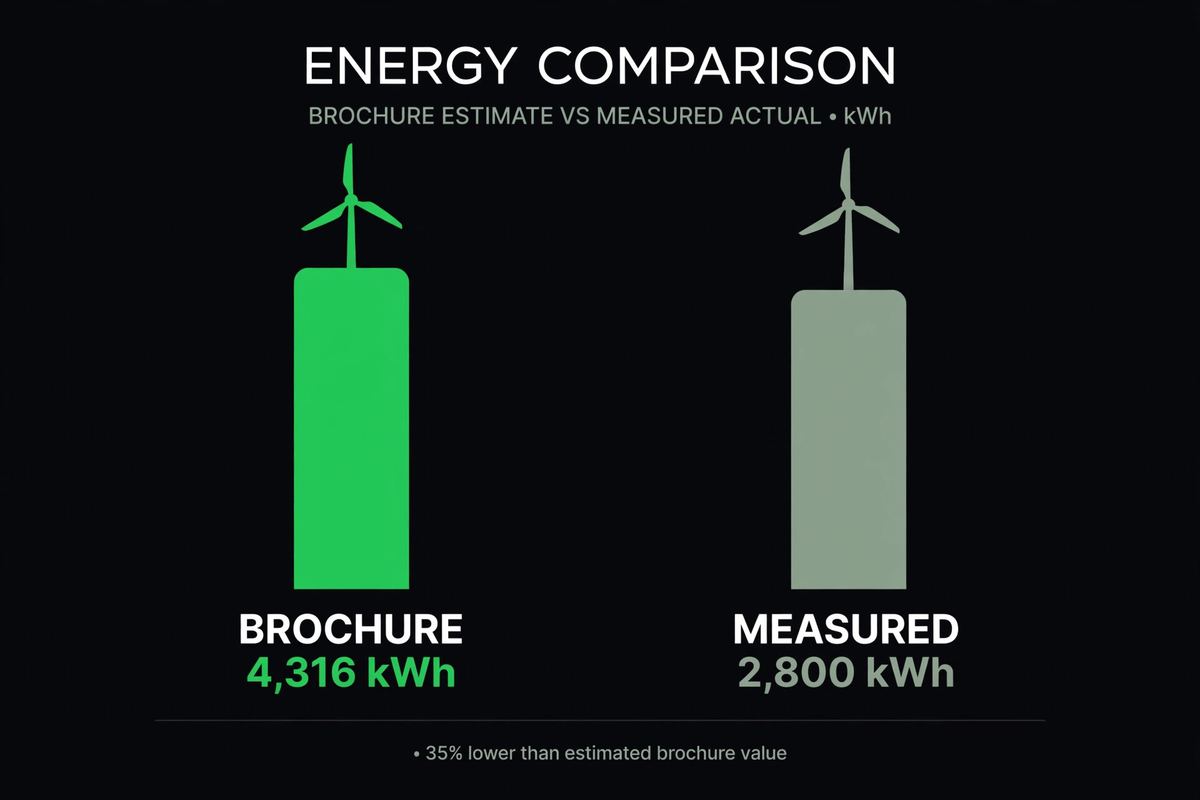
The manufacturer’s own curve for the Excel 10, measured at hub height, shows how violently output responds to small wind changes: 4,910 kWh per year at an 8 mph average, 9,850 at 10 mph, 16,530 at 12 mph, 24,330 at 14 mph, and 32,388 at 16 mph.
Read that curve as a buyer. A site averaging 10 mph instead of 12 loses 40 percent of its annual energy; a 14 mph site gains 47 percent. Two miles per hour of average wind, a difference no human can feel, decides whether the machine is a reasonable investment or an expensive lawn ornament. Your site’s true average wind speed at hub height, measured over a full year, matters more than the turbine’s rating.
The installed cost: about $12,000 per kilowatt
Residential wind turbine cost is the second shock. Pacific Northwest National Laboratory’s Benchmarking U.S. Small Wind Costs report, covering 70 projects (57 residential, 13 commercial, 10 turbine models, 16 states), found the average residential system cost $11,953 per kilowatt installed: turbine, tower, inverter, wiring, foundation, and labor.
For our example machine: 8.9 kW at $11,953 per kW is $106,382, rounded to $106,400 installed. Six figures is the realistic planning number for a 10 kW-class home installation, not the equipment-only prices advertised online.
Our calculation: $0.32 per kWh on paper, about $0.50 in the field
Now the arithmetic the brochures skip: installed cost divided by lifetime electricity delivered. We assume a 20-year service life with no financing cost and no maintenance counted, both of which flatter the result.
On brochure figures at a 12 mph site: 16,530 kWh per year, 330,600 kWh over 20 years. $106,400 divided by 330,600 kWh gives $0.32 per kWh.
Under the forum case’s real-world pattern, output runs about 65 percent of the estimate (2,800 / 4,316): roughly 10,700 kWh per year, or 214,000 kWh over 20 years. $106,400 / 214,000 kWh = $0.50 per kWh.
For comparison, EIA reports the 2025 average US residential electricity price at 17.3 cents per kWh. Rooftop solar: the National Laboratory of the Rockies’ 2025 benchmark puts residential solar at $2.95 per watt, so an 8 kW array costs about $23,600 installed, or about $0.09 per kWh at 11,000 kWh a year over 25 years.
| Option | Annual output (kWh) | Assumed life | Installed cost | Cost per kWh |
|---|---|---|---|---|
| 8.9 kW home turbine, brochure output at 12 mph site | 16,530 | 20 years | $106,400 | $0.32 |
| 8.9 kW home turbine, real-world pattern (65% of brochure) | 10,700 | 20 years | $106,400 | $0.50 |
| Grid electricity, US residential average 2025 (EIA) | n/a | n/a | n/a | $0.17 |
| 8 kW rooftop solar, typical US site (estimate) | 11,000 | 25 years | $23,600 | $0.09 |
Wind: 8.9 kW x $11,953/kW (PNNL); brochure output from the Bergey Excel 10 datasheet at 12 mph hub height; real-world ratio 2,800/4,316 = 64.9%. Solar: 8 kWdc x $2.95/Wdc (NLR 2025Q1); 11,000 kWh/yr assumed. All exclude financing and maintenance.
What $0.50 per kilowatt-hour means for a backyard turbine
At roughly three times the average grid price, a home turbine on an ordinary site loses money, and the industry’s own guidance agrees. DOE’s Small Wind Guidebook says a system works only with enough wind, tall towers allowed, enough space, known electricity needs, utility interconnection, and sound economics. Turbines big enough to matter generally need an acre or more; only about 19.3 percent of Americans live in rural areas with parcels that large.
The math closes in three narrow cases: remote properties beyond the grid, genuinely windy rural sites (an acre or more, a tall tower, measured average near or above 12 mph), and places with punishing electricity rates. EIA shows the spread: Hawaii averaged 35.72 cents per kWh in 2025, North Dakota 8.20 cents. The cruel geography is that the best wind economics sit where power costs most, while most wide-open windy land sits in cheap-power states.
Siting rules explain why suburbs are mostly excluded: PNNL distributed wind guidance wants blade tips at least 30 feet above obstacles within 500 feet and a minimum of one acre for setbacks, noise, and turbulence. Its resource floor is 4.0 meters per second (about 9 mph) annual average at 30-meter hub height. Below that, do not bother.
Per installed watt, residential wind costs about four times residential solar: $11.95 against $2.95. Panels generate on any unshaded roof; a turbine needs a windy acre and a tall tower. If outage resilience matters more than bill savings, our analysis of whether a home battery without solar panels is worth it covers that trade-off.
Five checks before you spend a dollar
If you have the land and the wind, run these checks in order.
1. Measure your wind at hub height for a full year. An anemometer on a MET pole, logging continuously, is the industry standard. The forum buyer did exactly this and still saw 65 percent of the estimate. Measure, then discount.
2. Confirm the 4.0 m/s floor and the tower rule. PNNL’s floor is 4.0 meters per second annual average at 30 meters height, with blade tips 30 feet above obstacles within 500 feet. If zoning caps your tower below that, the project is over.
3. Check zoning, permits, and setbacks first. Height limits, setbacks, and noise rules are set locally, and many residential zones cap structures below what a turbine needs. Get the written answer before ordering equipment.
4. Buy a certified turbine. PNNL recommends certified machines because their performance figures were independently tested, and the AWEA small-wind standard lets you compare annual energy across brands on equal terms.
5. Run your own dollars-per-kWh math. Take the brochure’s annual energy at your measured wind speed, multiply by 0.65, divide your all-in quote by that output times 20 years, and compare with your utility rate. If it is not comfortably below your rate, walk away, then price the solar alternative with our guide to how many solar panels you need.
Frequently asked questions
How much does a small wind turbine for a home cost?
Roughly $12,000 per kilowatt installed, per PNNL’s benchmark across 57 US residential projects. A 10 kW-class installation lands around $100,000 or more all-in; smaller 1 to 2 kW machines cost far less but produce a fraction of a home’s electricity.
How much electricity will a home wind turbine actually produce?
Home wind turbine output is decided almost entirely by your average wind speed at hub height. The Excel 10 datasheet shows 16,530 kWh per year at a 12 mph average but only 9,850 at 10 mph, and real-world output often lands near two-thirds of estimates. Plan around roughly 10,700 kWh per year on a good 12 mph site, far less on a mediocre one.
Can I put a wind turbine on my roof?
No. Building turbulence slashes output, and vibration and noise are serious problems. Guidance wants blade tips roughly 30 feet above obstacles within 500 feet, which no neighborhood roof can meet, so home turbines belong on a dedicated tower on open land.
Is a small wind turbine or rooftop solar the better buy for a home?
For most grid-connected homes, rooftop solar wins: about $2.95 per installed watt versus about $11.95 for small wind, and panels work on any unshaded roof while a turbine needs a windy acre, a tall tower, and a year of wind measurement. Wind earns its place at remote off-grid sites with strong, steady wind.