
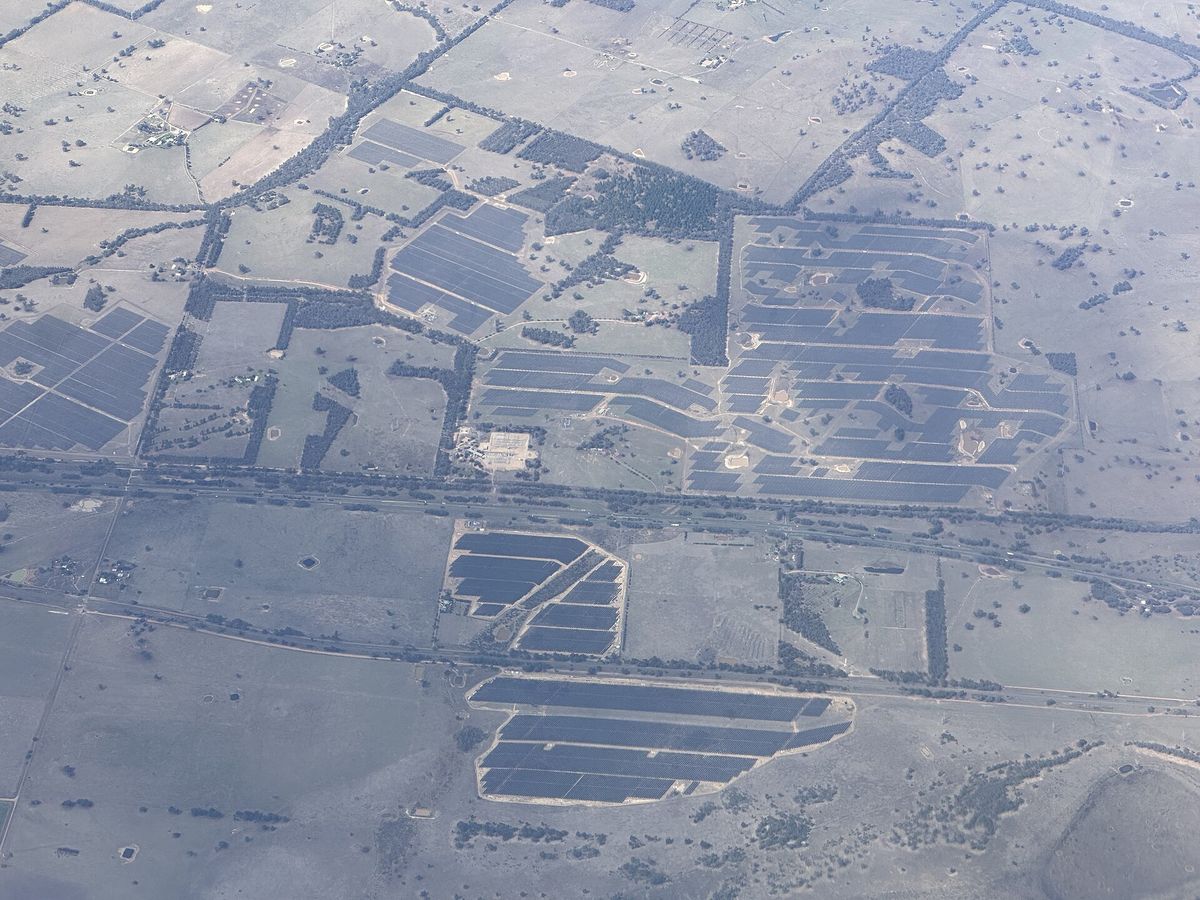
- DTE Energy has completed the 100-MW Cold Creek Solar Park near Coldwater, Michigan, the third DTE utility-scale solar plant to come online in 2026 under its MIGreenPower voluntary renewable program.
- The $194 million project was funded through Ford’s enrollment in MIGreenPower, part of a 2022 deal for up to 650 MW that was then the largest US renewable purchase agreement.
- The announcement quietly pushed back Ford’s target for Michigan-made vehicles built with the equivalent of 100% carbon-free electricity from 2025 to the end of 2027 — a deadline Ford never publicly explained.
The DTE Cold Creek solar park is officially generating power. DTE Energy announced on October 1 that it has completed the 100-MW facility near Coldwater, Michigan, which broke ground in April 2025. The project adds another major utility-scale installation to Michigan’s fast-growing solar pipeline — and it carries the financial fingerprints of Ford Motor Company, whose Michigan factories the park is designed to support.
Here’s the part worth paying attention to: Ford’s involvement traces back to a record-setting 2022 agreement to purchase up to 650 MW of renewable energy through DTE’s CleanVision MIGreenPower voluntary program — at the time, the largest US renewable purchase agreement by a company. The public goal was that every vehicle Ford builds in Michigan would be assembled with the equivalent of 100% carbon-free electricity by the end of 2025. DTE’s new announcement quietly moves that target to the end of 2027. No explanation accompanied the change.
Cold Creek is the third DTE utility-scale solar plant to come online in 2026 under the MIGreenPower program, following the 195-MW Mission Road project in June and the 146-MW Fish Creek project in August. At full output, Cold Creek alone generates enough electricity to power roughly 23,000 to 25,000 Michigan households. The project cost was reported at $194 million.
How the DTE Cold Creek solar deal fits Ford’s renewable program
MIGreenPower is DTE’s voluntary program that lets large customers — and, in a separate tier, residential subscribers — fund new renewable capacity matched to their electricity use. Ford’s 650-MW commitment was the program’s anchor tenant from the start, giving DTE the guaranteed offtake it needed to finance a string of large projects.
The structure matters because it’s a blueprint for how corporate decarbonization is actually getting built in the United States. Ford didn’t buy solar panels or build a power plant; it committed to buy the output, and DTE built the infrastructure. When the Cold Creek Solar Park 100 MW facility and its siblings Mission Road and Fish Creek are all humming, Ford’s Michigan manufacturing footprint — which includes some of the industry’s most energy-intensive assembly operations — will draw from a growing pool of home-state renewable generation.
That “equivalent of 100% carbon-free” language is worth a pause. Ford’s factories don’t literally run on solar electrons; the grid mixes everything together. What the program guarantees is that DTE generates — or buys on Ford’s behalf — an amount of carbon-free electricity equal to what Ford’s Michigan operations consume. It’s the standard book-and-claim model used by virtually every corporate renewable claim in the US. That’s not a criticism — it’s how grid-scale clean power accounting works — but readers should understand the difference between the marketing and the physics.
The deadline that slipped from 2025 to 2027
The real news here may be what DTE’s announcement didn’t say. Ford’s 2022 pledge was unambiguous about 2025 as the target year. Four years later, with the third of the supporting solar plants only now coming online, the target has quietly become “by end of 2027.” Neither Ford nor DTE has publicly explained the two-year delay.
This isn’t an indictment of either company. Building 650 MW of renewable capacity in four years is genuinely hard — permitting, interconnection queues, equipment procurement, and construction all run on timelines that no corporate press release controls. Michigan’s interconnection backlog and the broader post-2022 supply chain squeeze are plausible culprits. But the silence around the change illustrates a broader pattern in corporate climate commitments: the pledges get press releases; the recalibrations get buried in vendor announcements.
Corporate pledges vs. delivery: a pattern worth watching
Ford is hardly alone. Corporate renewable targets set in 2021–2022 — the peak era of the net-zero pledge wave — are hitting their original deadlines right about now, and many are quietly extending. The gap between pledge and delivery isn’t evidence of bad faith so much as evidence that large-scale clean energy construction is slower and harder than the slide decks implied. What would build trust is disclosure: saying what slipped, why, and what changed. On that measure, the Ford solar Michigan factories commitment got a two-year delay with zero public accounting.
DTE’s accelerating solar buildout
Whatever the pledge timeline, the physical buildout is real. DTE now operates 20 wind parks and 36 solar projects across Michigan, together powering nearly 1 million homes. Three utility-scale solar plants in a single year is a meaningful construction pace for a utility in the Midwest — and it reflects Michigan’s transformation into a serious solar market. The Solar Energy Industries Association projects more than 9.1 GW of solar will be installed in Michigan over the next five years.
DTE’s own integrated resource plan points further out: 15 GW of new renewables plus 4.5 GW of storage between 2027 and 2046. That trajectory puts the company on course to be one of the Midwest’s largest renewable generators, and the Cold Creek Solar Park 100 MW facility is a mid-sized piece of a much larger portfolio. For context on the scale of utility builds happening across the country, similar corporate-backed projects like the Texas utility-scale solar fleet and niche commercial installations such as the Six Flags Magic Mountain solar carport show how differently the same economics play out at different scales.
What this means for Michigan’s clean energy moment
Michigan is an interesting case study for the clean-energy transition in industrial America. It’s a manufacturing state with an auto industry anchor, a regulated-utility structure, and a relatively new embrace of utility-scale solar. The Cold Creek project shows the flywheel working: corporate demand unlocks utility-scale builds, which add jobs and tax base, which build political support for more.
That flywheel is sensitive to policy, though. Federal support structures — the fate of which has been in flux — can make or break project economics at exactly the margin where utility-scale solar competes with gas. Michigan’s solar momentum today owes something to policies that may look different tomorrow, as ongoing court battles over federal solar programs remind the industry.
The question for the next two years is execution. DTE has the projects, Ford has the demand, and the 2027 target gives both sides a credible runway. If the remaining MIGreenPower capacity lands on schedule, the slipped deadline will look like a footnote — a two-year delay on a generational industrial transition. If more plants stall in interconnection queues, it will look like something else: the moment corporate America’s net-zero pledges met the messy reality of building at grid scale. Either way, the meter is running, and this time everyone can see the date.
Project details come from Solar Power World’s report on the Cold Creek completion, Electrek’s coverage of Ford’s backing for the project, and NextMSC’s write-up of the 100-MW Michigan plant.