
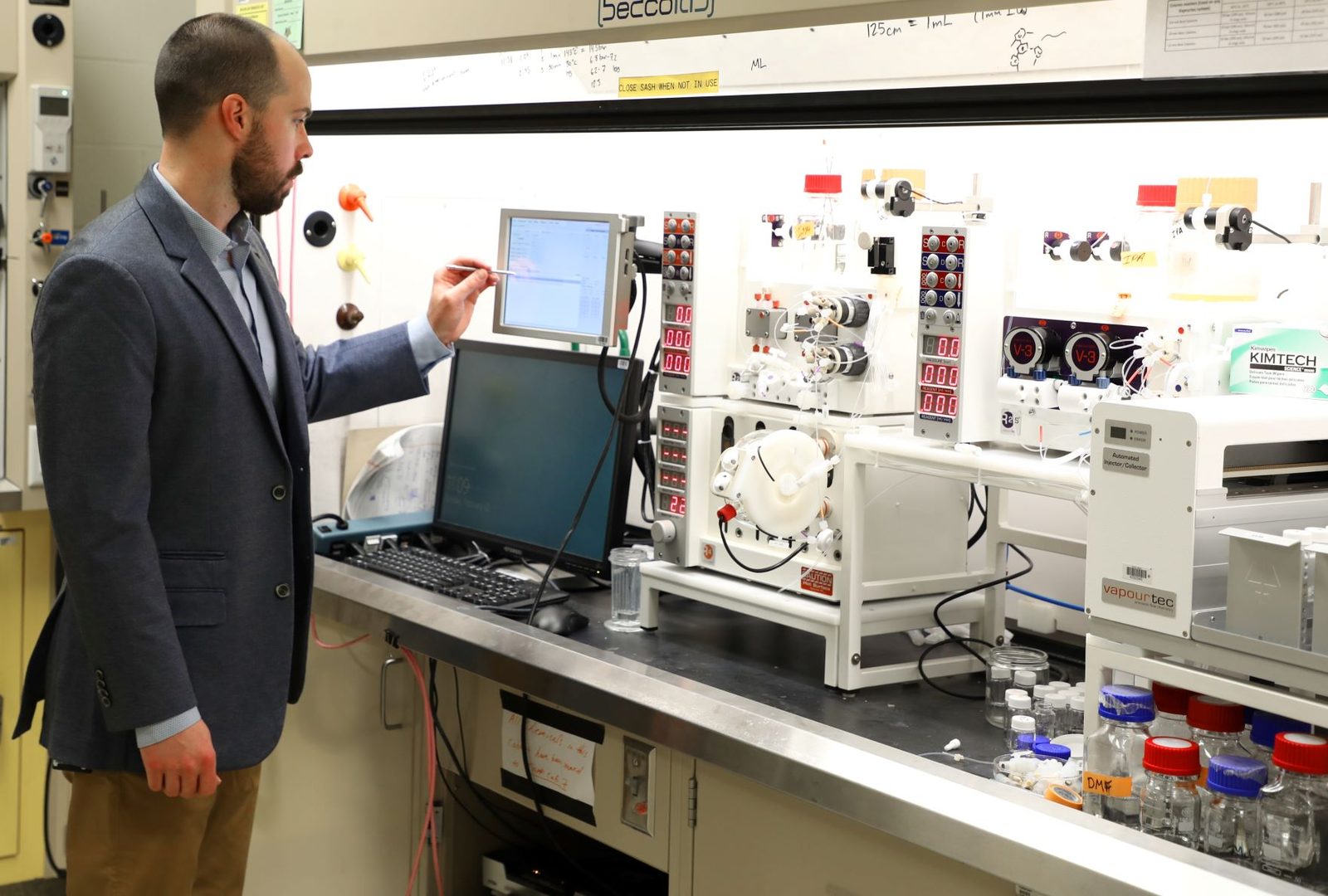
- Oregon State researchers have filed a patent on BVR-X, a new metal-organic framework (MOF) carbon-capture material that separates water from CO₂ inside its nanopores.
- Because humidity no longer blocks adsorption sites, BVR-X removes the costly flue-gas-drying step that can make point-source capture economically nonviable.
- Published in Angewandte Chemie and tested on a humid 4% CO₂ gas stream typical of natural gas plants, the material held performance across dozens of capture-and-release cycles.
A humidity problem that has long dogged carbon capture technology may have met its match in a laboratory at Oregon State University. Scientists there have developed BVR-X, a new MOF carbon capture material that turns moisture, historically the enemy of gas-separation chemistry, into a non-issue by routing water and carbon dioxide to different regions inside its nanopores. The research, published in the journal Angewandte Chemie and announced by Oregon State around October 1, 2026, comes with a patent application already filed.
The result matters because of where carbon capture actually happens. Most existing capture technology targets the smokestacks of industrial plants and gas-fired power stations, where exhaust streams are both dilute and wet. Humidity competes with CO₂ for the active sites inside capture materials, so operators must often dry the flue gas before capture can work at all: an energy-hungry step that can make the whole process too expensive to bother with. BVR-X sidesteps that step entirely.
How the BVR-X MOF carbon capture material works
Metal-organic frameworks are crystalline materials with enormous internal surface areas: a gram can contain more surface than a football field. That sponge-like structure makes them attractive for trapping specific gas molecules, but many MOFs are water-loving. In a humid exhaust stream, water molecules crowd into the pores first and block the sites where CO₂ would otherwise attach.
BVR-X takes a different approach. Rather than trying to repel water from the whole structure, its pore architecture directs water and CO₂ toward different regions within the nanopores, so the two molecules stop competing for the same sites. The material effectively turns humid flue gas into an advantage for carbon capture rather than a handicap. The advance is about maintaining performance in the messy, moisture-laden gas streams that real factories produce, rather than trapping more CO₂ per gram.
The team tested BVR-X on a highly humid gas stream containing just 4% CO₂, roughly what comes off a natural gas combustion process, and found it kept capturing effectively. They then regenerated the material and put it through dozens of capture-and-release cycles with no meaningful degradation, the researchers report. Repeatable cycling matters enormously for economics: a capture material that degrades after a handful of cycles is a consumable, while one that survives thousands is infrastructure.
| Item | Figure |
|---|---|
| Test gas stream | Highly humid, 4% CO₂ (typical of natural gas combustion) |
| Demonstrated cycling | Dozens of capture-and-release cycles, no meaningful degradation |
| Industrial cycle-life requirement | Thousands to tens of thousands of cycles |
| Direct air capture concentration | ~0.04% CO₂ |
| Industry share of US greenhouse gas emissions | ~30% (EPA) |
| Hard-to-abate sectors | Cement, steel, chemicals, gas-fired power |
Why humidity is the real battleground for point-source capture
To understand the significance, it helps to separate the two branches of carbon capture. Direct air capture pulls CO₂ from ambient air at about 0.04% concentration, a thermodynamically brutal proposition. Point-source capture, by contrast, goes after concentrated exhaust at the smokestack, and it is by far the more mature approach. Industry accounts for roughly 30% of U.S. greenhouse gas emissions, according to the EPA, and sectors like cement, steel, chemicals, and gas-fired power have few near-term paths to deep decarbonization other than capturing CO₂ at the source.
Yet point-source capture has its own Achilles’ heel: the gas it must process is wet. Flue gas from combustion carries substantial water vapor, and conventional adsorbents lose efficiency fast in that environment. Drying the gas first is possible, but it adds capital equipment and parasitic energy load, and in the economics of carbon capture, parasitic energy is the metric that decides whether a project lives or dies. A material that works well wet could therefore remove one of the biggest cost penalties from the technology stack.
From lab to patent: the team behind BVR-X
The research was led by Kyriakos Stylianou, a professor of chemistry and director of Oregon State’s Materials Discovery Laboratory, with collaborators from UC Berkeley, the University of Oregon, and the ARAMCO R&D Center. Funding came from Saudi Aramco, the Murdock Charitable Trust, and the OSU Foundation.
That Aramco footprint is worth watching. The world’s largest oil producer has spent heavily on carbon management research in recent years, and a natural gas producer has obvious interest in capture technology tuned to exactly the kind of 4% CO₂ humid gas stream BVR-X was tested on. A pilot demonstration backed by an industrial partner would be the natural next step from a patented lab result to something engineers can price into real projects. For context on how captured CO₂ moves downstream, see Joule Post’s coverage of a 100 MW compressed-CO₂ energy storage project in Xinjiang, where the gas is repurposed as a grid-scale storage medium rather than vented.
From lab powder to Oregon pilot: the scale-up questions
Enthusiasm for any capture breakthrough should be tempered with the standard checklist for lab-stage materials. First is cycle life: “dozens of capture-and-release cycles” is a promising start, but industrial adsorbents need to survive thousands, ideally tens of thousands, of cycles to justify their replacement cost. Second is manufacturing scale: MOFs have a well-documented history of dazzling in the lab and stumbling on cost and scalability when production ramps up. Third is the full-system energy accounting: the material removes the drying step, but the regeneration step, releasing captured CO₂ so the material can be reused, still costs energy, and that cost will determine the economics of any eventual deployment.
There is a deeper reason the drying-step removal matters more than a simple efficiency gain. A humidity-tolerant material collapses a two-unit process (dry the gas, then capture the CO₂) into a single unit operation. In process economics, eliminating an entire piece of equipment is worth more than improving one. The dryer’s capital cost, energy load, and maintenance all disappear at once, which is why this class of advance tends to move capture economics in discrete jumps rather than gradual improvements.
None of that diminishes the genuine news here. Peer-reviewed results solving the humidity problem, the single biggest practical blocker for MOF-based point-source capture, with dozens of demonstrated stable cycles is a real step forward for industrial decarbonization technology. It also follows a pattern of university lab breakthroughs that Joule Post has tracked before, from solid-state batteries to record-efficiency perovskite solar cells, where the gap between published result and deployed product is precisely what determines whether a discovery matters.
If the cycle life holds: what BVR-X would change
Carbon capture has spent decades fighting water. BVR-X wins by redesigning the battlefield so water and CO₂ stop competing for the same space. If the material’s cycle life holds up through further testing and it can be made at industrial scale, the removal of the flue-gas-drying step would meaningfully improve the economics of capturing emissions from gas plants, cement kilns, and chemical facilities. That makes it one of the more technically grounded capture advances of the year, and one where the next milestone, an industrial pilot, is clearly defined. Anyone following materials science breakthroughs may also appreciate Joule Post’s explainer on battery chemistries, another field where pore-level chemistry decides commercial outcomes.