
- Can an HOA deny solar panels? In the six states we checked, no: each statute voids or forbids outright bans.
- The tests differ: California caps added cost at $1,000 and output loss at 10%; Maryland uses 5% cost and 10% generation thresholds since October 2025; Arizona and Colorado use a qualitative “reasonable” standard.
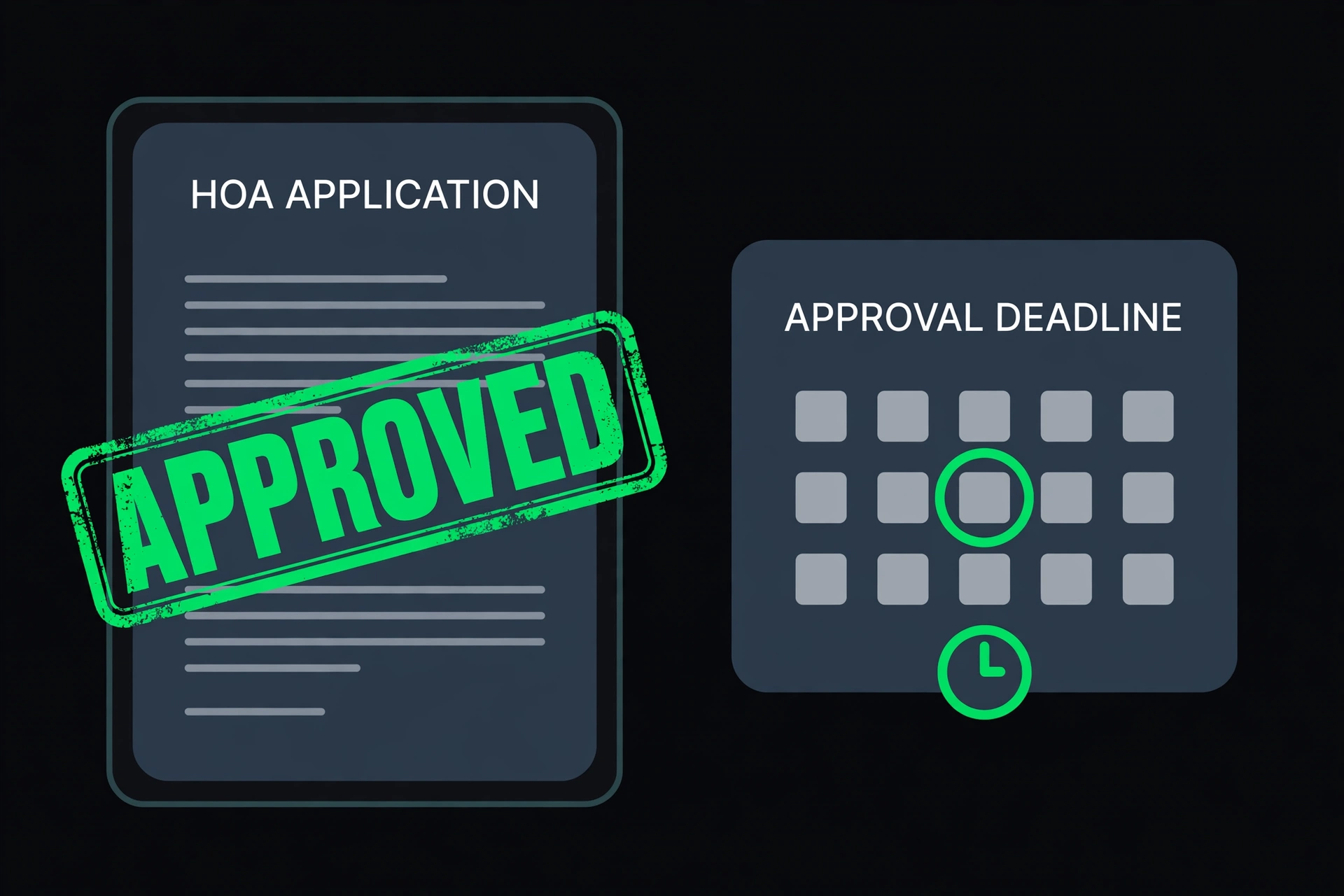
- California is the only one with a statutory response deadline: 45 days of silence means deemed approval.
Solar access laws: State laws that limit how much a homeowners association, and sometimes a city or county, can restrict rooftop solar. They typically void outright bans and set tests for when an HOA rule goes too far, such as caps on added cost or lost output, deadlines for decisions, and penalties for violations. Details vary widely by state.
This article explains what the statutes say; it is not legal advice. Where a solar rights law exists, the statute overrides the HOA’s rulebook; where none exists, the governing documents usually control. This guide compares six states whose solar access statutes we verified from the official text, and our primer on how solar panels work covers the technical basics.
So, can your HOA deny solar panels?
It can try, but in the states covered here the attempt is likely void. All six statutes share one rule: a covenant, deed restriction, or HOA provision that “effectively prohibits” solar is unenforceable. They diverge on what counts as going too far: some set hard numbers, others use a vaguer “reasonable restriction” test, and all carve out exceptions for common areas, historic properties, and safety.
California: the strongest solar protections in the country
California’s Solar Rights Act is the most detailed. Civil Code section 714 voids any covenant, restriction, or HOA governing-document provision “that effectively prohibits or restricts the installation or use of a solar energy system.” For rooftop photovoltaics, “significantly” means more than $1,000 added to the system cost “as originally specified and proposed,” or an efficiency cut of more than 10 percent against that design.
Section 714(e)(2) puts a clock on the board: no written denial within 45 days of receipt means deemed approval, absent a reasonable request for more information. Section 714.1 bars general anti-solar policies and membership-vote requirements; willful violations bring damages plus a penalty of up to $1,000, and the winner recovers attorney’s fees. Limits exist: in Tesoro Del Valle Master Homeowners Assn. v. Griffin (2011), a California appeals court upheld an HOA restriction where a comparable cheaper system with 14 percent less output was available, an alternative the statute expressly allows.
Six states, six different tests
Each statute below was verified against the official legislature or government text.
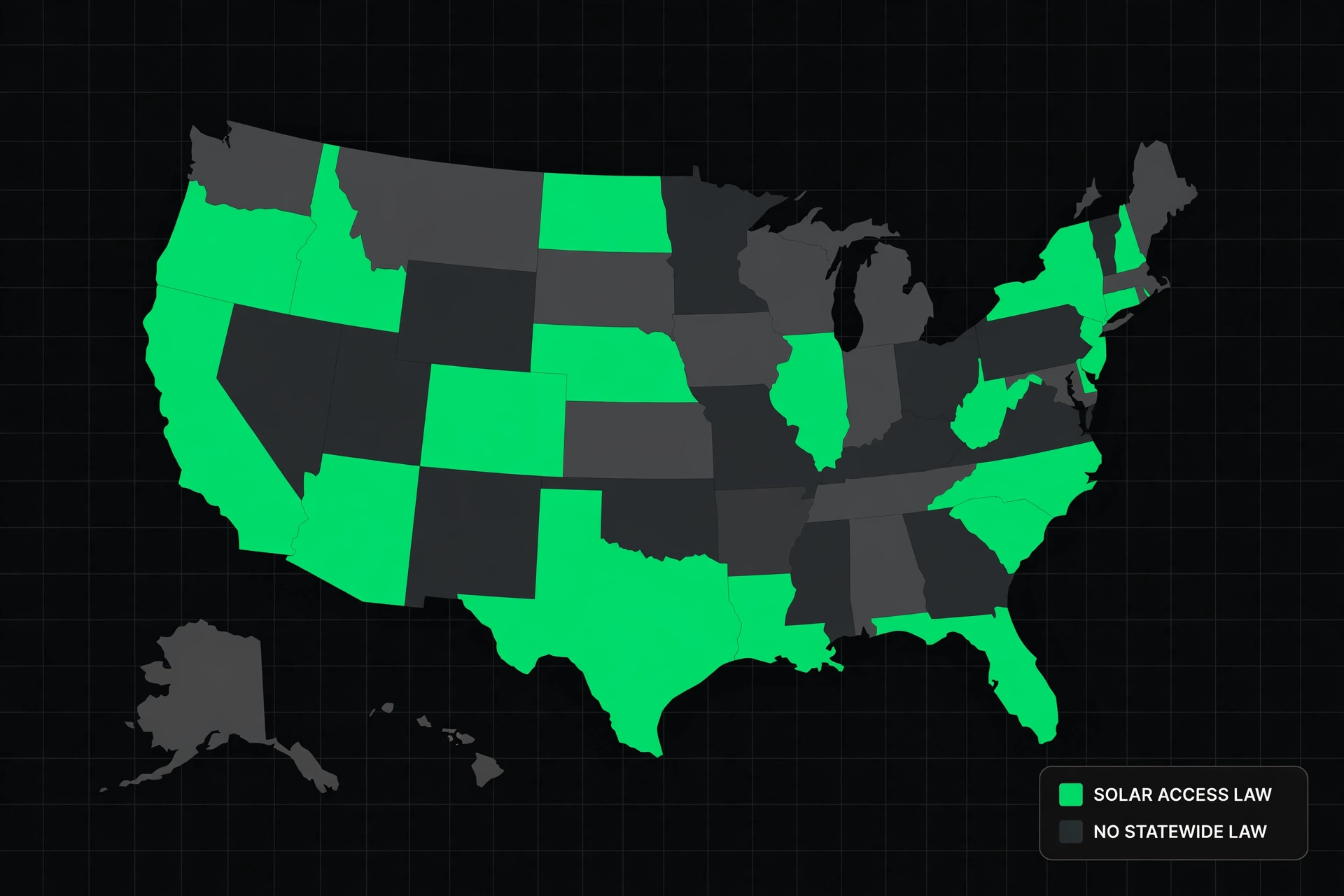
| State | Statute | Can the HOA ban solar outright? | Cost / output limits | Approval deadline |
|---|---|---|---|---|
| California | Civ. Code §§ 714, 714.1 | No; ban is void | Cost capped at $1,000, efficiency loss at 10% vs. proposed design | 45 days; silence = deemed approved |
| Arizona | ARS § 33-1816 | No; ban is prohibited | None; placement rules must not affect cost, efficiency, or function | None in statute |
| Texas | Property Code § 202.010 | No; violating provision is void; 8 exceptions | Owner’s alternate roof spot stands unless HOA’s spot loses ≤10% of annual output (NREL tool) | “Reasonable period” or per CC&Rs |
| Florida | § 163.04 | No; HOA and city bans both barred | HOA roof-spot pick limited to south ±45° E/W, if operation unimpaired | None in statute |
| Colorado | C.R.S. § 38-33.3-106.5(1.5); § 38-30-168 | No; “effectively prohibit” barred | Qualitative “significant” test only | None in statute |
| Maryland | Real Property § 2-119 (amended 2025) | No “unreasonable limitations” | Since Oct 2025: unreasonable if cost +5% or generation −10% | None in statute |
Only California and Maryland give homeowners a number to cite. Texas and Florida skip cost caps and draw lines around placement: Texas lets you override the HOA’s roof spot when yours yields over 10 percent more annual energy; Florida confines the HOA’s choice to south plus or minus 45 degrees. Texas’s 2025 House Bill 431 also clarified that “solar energy device” includes solar roof tiles, effective September 1, 2025.
Where an HOA can still push back
No statute here gives homeowners a blank check. Common areas are the biggest carve-out: California lets associations restrict solar there to approved systems, Texas exempts association-owned or common property, and Maryland lets boards regulate common-area systems. Maryland also exempts historic properties on the state register. Texas has the longest exception list: court-found safety threats, off-slope or above-roofline panels, non-conforming visible hardware, ground systems taller than the fence line, warranty-voiding installations, and systems installed without required approval. Genuine safety and code requirements survive everywhere; these statutes police aesthetic overreach, not electrical standards.
Why delay hurts more in 2026 than it used to
The federal economics changed this year. The residential clean energy credit (26 U.S.C. section 25D) is unavailable for expenditures made after December 31, 2025, per IRS Fact Sheet FS-2025-05; the expenditure counts as made when installation is completed. Paying in 2025 but finishing in 2026 does not qualify. With the 30 percent credit gone, every month a board delays eats into the homeowner’s savings. Our post-credit analysis works through the new math. California’s 45-day rule now carries practical weight. Elsewhere there is no statutory clock, so check your CC&Rs for a review timeline and keep delivery proof. Texas’s “reasonable period” language is worth citing when a board goes quiet.
Why a flat $1,000 cap matters more after the credit ended
Here is the analysis none of the source documents spell out. California’s $1,000 cap is flat: it does not scale with system size or net cost, so on a large system it is a small fraction and on a small one it is larger. Maryland’s 2025 amendment took the opposite approach: a 5 percent threshold scales automatically, giving a $30,000 system $1,500 of headroom and a $15,000 system $750. While the credit absorbed 30 percent of gross cost, that difference was academic; without it, the flat cap bites hardest on smaller systems, exactly what many HOA rooftops can fit. Maryland’s House Bill 4 (signed May 13, 2025; effective October 1, 2025) also requires claims to be backed by a NABCEP-certified specialist or affidavit from someone who designed at least 30 systems in the prior three years, which makes the numbers harder for a board to dismiss. See our 50-state payback ranking for 2026.
Your 5-step playbook before you apply
First, read your state’s actual statute via the official links above. Second, get the installer’s proposed design in writing with projected cost and annual production; California and Maryland measure disputes against it. Our sizing guide can help you sanity-check it. Third, submit a complete written application and keep proof of delivery; in California the 45-day clock runs from receipt. Fourth, if the board demands changes, ask for the cost and output impact in writing. Fifth, document everything.
Frequently asked questions
Can my HOA prevent me from installing solar panels?
In the six states covered here, statutes void or prohibit HOA bans on rooftop solar, with limited exceptions for common areas, safety, and placement. In states with no solar access law, the governing documents usually control, and a board has far more room to refuse.
Can a California HOA stop you from installing solar panels?
Not with a blanket ban: section 714.1 voids general policies against household rooftop solar, no membership vote can be required, conditions cannot add over $1,000 to the proposed cost or cut efficiency by over 10 percent, and no written denial within 45 days means deemed approval.
What can I do if my HOA ignores my solar application?
In California, no written denial within 45 days of receipt means deemed approval. Elsewhere: check your CC&Rs for a review timeline, follow up in writing, and keep delivery receipts. Texas requires a “reasonable period,” which you can cite. If a board stalls indefinitely, get a local attorney involved.
Can my HOA force my panels onto a worse part of the roof?
Sometimes, but the statutes cap the sacrifice. In Texas you can override the HOA’s roof location if yours produces over 10 percent more annual energy, per a public NREL modeling tool. In Florida the HOA’s spot must face south within 45 degrees east or west without impairing the collectors. In California any HOA-mandated move cutting efficiency by over 10 percent fails the test.