
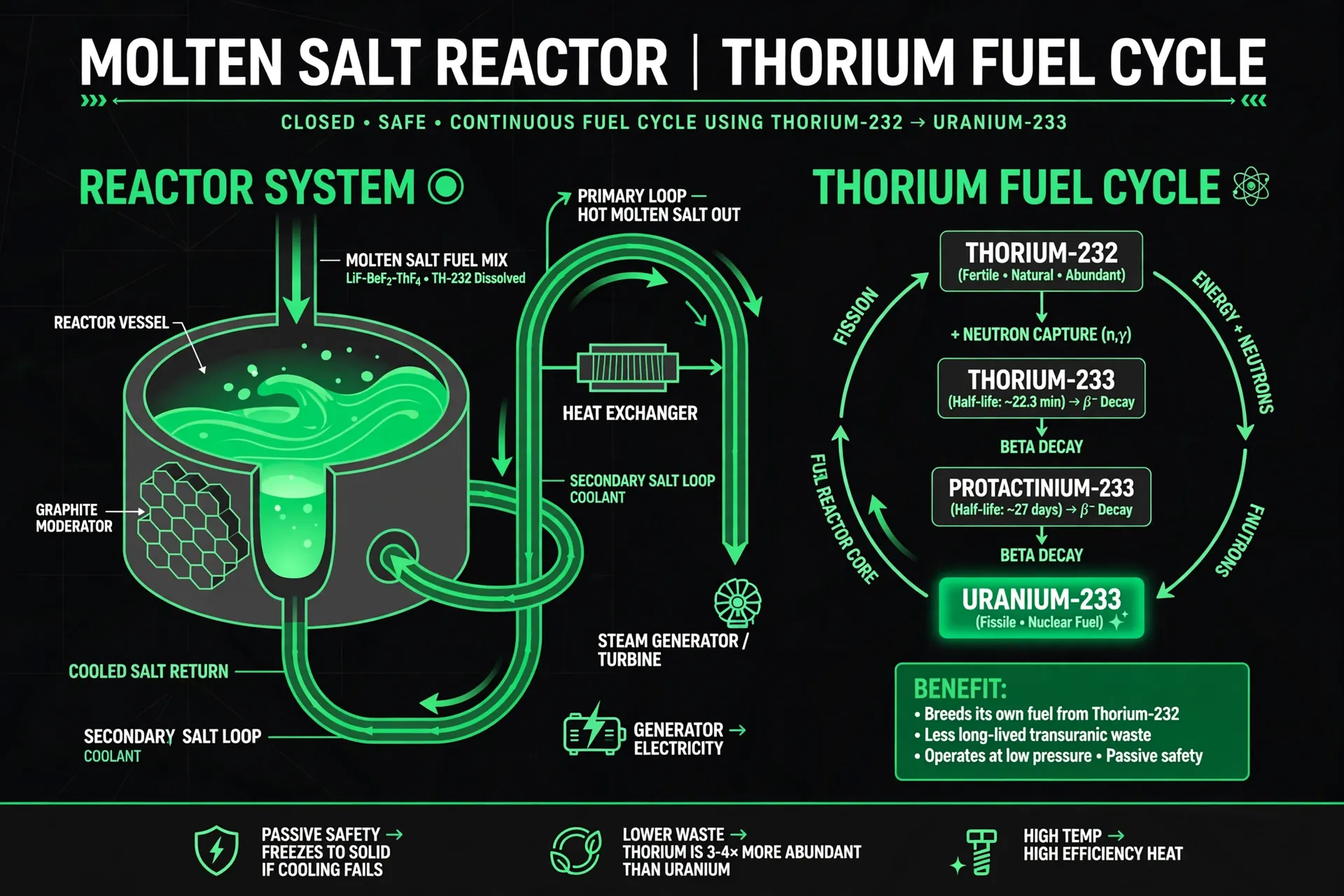
- Thorium-232 cannot split on its own. It must first absorb a neutron and change, through protactinium-233, into fissile uranium-233.
- China’s TMSR-LF1 is a 2 MWt experimental molten salt reactor. In November 2025 its operator announced the first conversion of thorium to uranium fuel inside it.
- No thorium reactor supplies power to a commercial grid today. The barriers are licensing, fuel handling, cost and an entrenched uranium supply chain, not a single missing discovery.
Thorium reactor: A thorium reactor is a nuclear reactor that uses thorium-232, a fertile metal, as its main fuel material. Because thorium-232 cannot sustain fission on its own, neutrons convert it into uranium-233, which then splits and releases heat. That heat makes steam, which drives a turbine, much as in a conventional nuclear plant.
This thorium reactor explained guide starts with a plain fact: thorium is not a drop-in replacement for uranium. It is a different fuel system, with a different starting step, different handling problems and a different set of reactors that suit it best. That distinction explains both the long-running enthusiasm for thorium and the long delay in using it at scale. The recent news from China does not change that picture overnight, but it does add a real experimental result to a debate that has often run on promise alone.
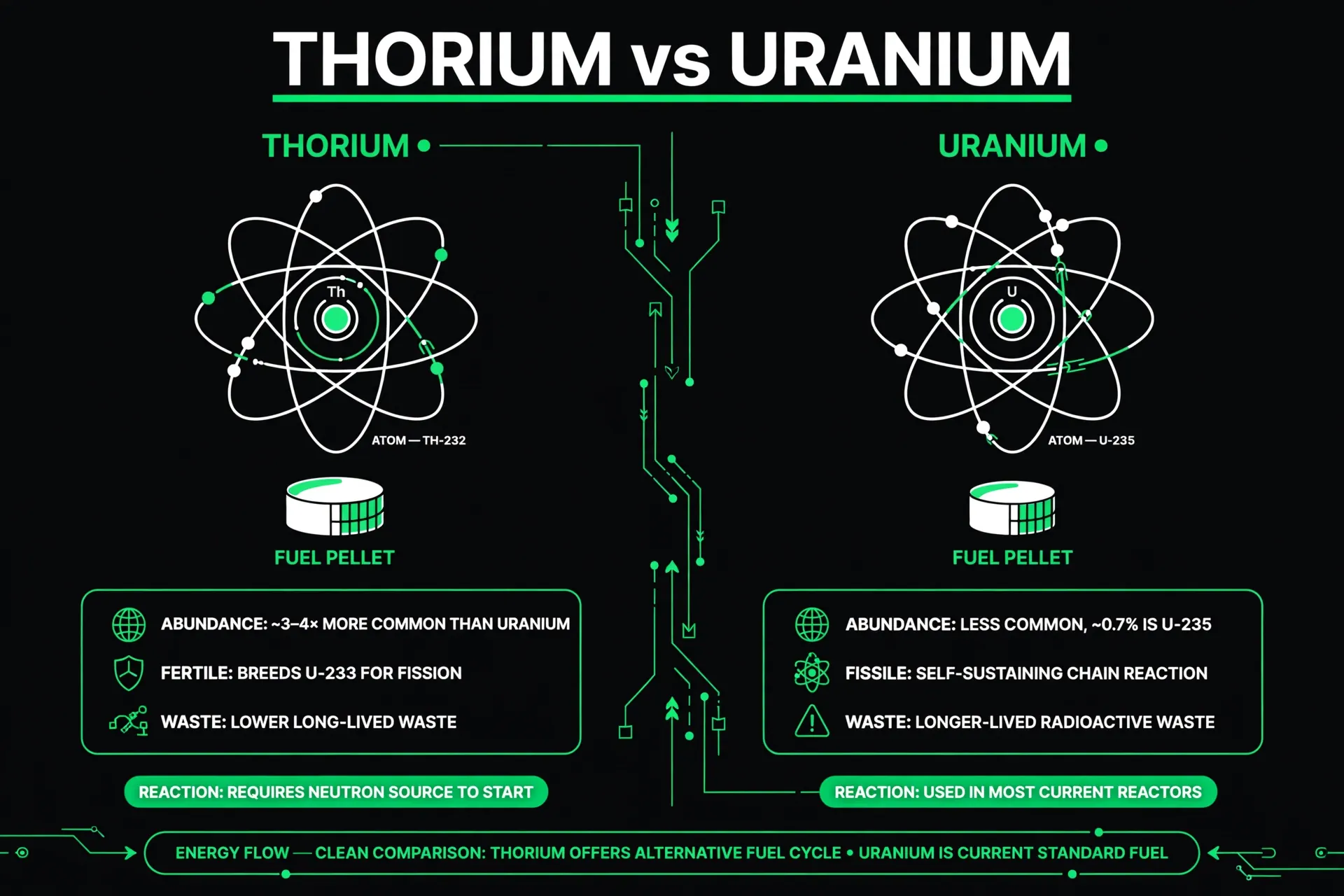
Thorium appears in most rocks and soils, and the World Nuclear Association’s thorium overview puts its crustal abundance at about three times that of uranium. It is usually recovered from monazite, a mineral mined mainly for rare earth elements, and the same overview cites identified world thorium resources of about 6.36 million tonnes from the OECD Nuclear Energy Agency and International Atomic Energy Agency Red Book compilation. Abundance alone, however, does not make a fuel cheap or practical. The steps between rock and reactor matter more than the size of the resource.
Thorium reactor explained: the fuel cycle in plain terms
The core idea takes three steps. First, a fissile driver starts the reaction. That driver can be uranium-235, plutonium-239 or uranium-233 recycled from earlier thorium use. Second, neutrons from that driver strike thorium-232 nuclei. Each thorium-232 nucleus that absorbs a neutron becomes thorium-233, which decays within minutes to protactinium-233, which then decays over about 27 days to uranium-233. Third, that uranium-233 splits, releases heat and releases more neutrons, which keep the cycle going and convert more thorium.
The distinction between fertile and fissile material is the point on which most popular explanations go wrong. A fissile nucleus splits readily when struck by a slow neutron and sustains a chain reaction. A fertile nucleus does not. It must first be converted into a fissile nucleus. Thorium-232 is fertile. Uranium-238, the dominant isotope in natural uranium, is also fertile, and it converts to plutonium-239 in a similar way. Thorium is therefore not unique in needing a conversion step. It is unusual because the fissile product, uranium-233, releases slightly more neutrons per fission on average than uranium-235 or plutonium-239 in a thermal neutron spectrum, according to the World Nuclear Association. That neutron surplus is what makes breeding, the production of more fissile material than the reactor consumes, theoretically possible in a slow-neutron thorium system in a way that is not possible with uranium fuel alone.
Breeding is possible in theory and difficult in practice. The World Nuclear Association notes that thermal breeding with thorium requires a very efficient neutron economy, meaning very low losses to leakage and to absorption by materials that do not produce useful fissions. Reactor designers therefore separate the fuel into a seed region, where the fissile driver sits and power density is high, and a blanket region, where thorium sits and absorbs surplus neutrons. In a molten salt design, that separation can take the form of separate salt circuits, one for the core and one for the blanket. In a solid-fuel design, it takes the form of different fuel pins or assemblies. Either way, the design must protect the neutron balance at every step, because protactinium-233 itself absorbs neutrons, and every neutron lost to protactinium is a neutron that cannot convert another thorium nucleus.
Thorium can also be used in several existing reactor types, not only in molten salt reactors. The World Nuclear Association lists heavy water reactors, high-temperature gas-cooled reactors, boiling water reactors, pressurised water reactors, fast neutron reactors and accelerator-driven systems as thorium-capable, with molten salt reactors as the experimental case that fits thorium most naturally. Heavy water reactors suit thorium because they waste few neutrons. High-temperature gas-cooled reactors suit it because their coated particle fuel can survive very high burn-up. Pressurised water reactors, the industry workhorse, can use thorium fuel but with less flexibility and less conversion to uranium-233. That range matters for any realistic timeline, because a fuel that only works in a reactor type that does not yet exist commercially faces a longer path than a fuel that can be tested in machines already licensed and operating.
What China actually built at Wuwei
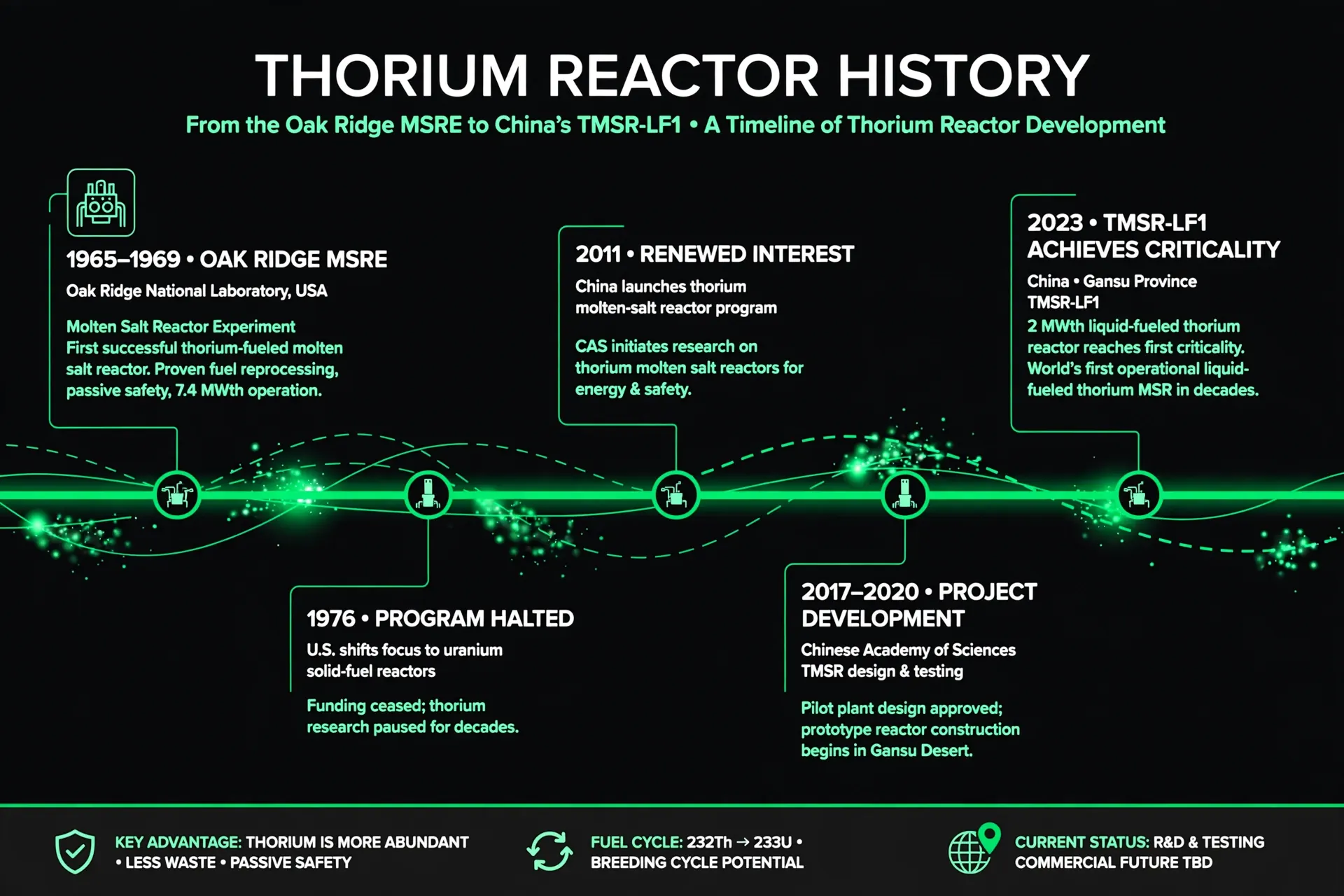
The reactor at the centre of the recent news is TMSR-LF1, a liquid-fuel experimental reactor at Wuwei in Gansu province, built by the Shanghai Institute of Applied Physics (SINAP) of the Chinese Academy of Sciences. According to World Nuclear News, construction began in September 2018, an operating licence was granted in June 2023, and the reactor first reached criticality, a sustained chain reaction, on 11 October 2023. The World Nuclear Association adds that the reactor reached full power in June 2024 and became the first molten salt reactor in the world to have thorium loaded into it in October 2024.
The technical details reported for TMSR-LF1 are modest in scale and specific in design. Its thermal power is 2 MWt. Its fuel uses uranium enriched to under 20 percent uranium-235, below the threshold commonly used to define highly enriched uranium. Its thorium inventory is about 50 kg. Its fertile blanket uses lithium-beryllium fluoride salt, known as FLiBe, with 99.95 percent lithium-7, and its fuel salt carries uranium tetrafluoride. Its conversion ratio, the ratio of new fissile material produced to fissile material consumed, is about 0.1, according to World Nuclear News. That figure is important because it shows what this machine is and is not doing: it is converting thorium and proving the chemistry and operation of the cycle, but it is not breeding. A conversion ratio of 0.1 means the reactor produces roughly one new fissile nucleus for every ten it consumes, so it still depends on its uranium driver for most of its fissions.
On 1 November 2025, SINAP announced that TMSR-LF1 had achieved the first conversion of thorium to uranium fuel. World Nuclear News reported the institute’s statement that this was the first time experimental data had been obtained after thorium was introduced into a molten salt reactor, and that TMSR-LF1 was the only operating molten salt reactor in the world to have incorporated thorium fuel. The institute also said the liquid fuel design allows refuelling without shutting the reactor down, because the fuel is dissolved uniformly in the circulating salt rather than held in fixed assemblies that must be removed. That operating feature is genuine, and it is one of the practical attractions of liquid fuel. It does not by itself prove commercial viability, because the chemical processing plant that must continuously clean the salt, remove fission products and handle protactinium is itself a complex facility that has not yet been demonstrated at commercial scale.
SINAP’s stated next step is a 100 MWt thorium-based molten salt demonstration reactor, with demonstration applications targeted by 2035, according to World Nuclear News. The World Nuclear Association reports a related plan for a 10 MWe (30 MWt) small modular research reactor at the Wuwei site targeting first criticality in 2030. Those two figures describe different machines on the same development path, and readers should not merge them into one project. The path from a 2 MWt experiment to a 100 MWt demonstration, and then to a commercial power plant, still requires a licensed design, a supply chain for specialised salts and materials, and an operating record measured in years rather than months.
The 1960s experiment America ran first
China is not the first country to run a molten salt reactor. In the 1960s, Oak Ridge National Laboratory in the United States designed and built a demonstration molten salt reactor that ran from 1965 to 1969 at powers up to 7.4 MWt, using a lithium-beryllium salt at 600 to 700 degrees Celsius and ambient pressure, according to the World Nuclear Association. In its second campaign it used uranium-233 as the main fissile driver. The programme showed that a liquid-fuel salt reactor could operate, and it also identified corrosion and safety issues that a larger pilot reactor would need to solve. The United States programme ended in the 1970s, and no commercial molten salt reactor followed.
Thorium fuel also generated electricity in other reactor types well before the current molten salt work. Germany’s 300 MWe Thorium High Temperature Reactor at Hamm-Uentrop operated with thorium and highly enriched uranium fuel from 1983 to 1989 before shutting down after technical problems. The 40 MWe Peach Bottom reactor in the United States ran from 1967 to 1974 on thorium fuel and produced more than 0.8 billion kilowatt-hours. The larger 330 MWe Fort St Vrain reactor in Colorado ran from 1976 to 1989 and used almost 25 tonnes of thorium in its fuel. At Shippingport in the United States, a light water breeder reactor operated from 1977 to 1982 at 60 MWe, used uranium-233 as its fissile driver, and ended its core life with 1.39 percent more fissile fuel than it started with, a result the World Nuclear Association cites as proof that breeding had occurred, with a breeding ratio of 1.01 quoted in a 2007 United States Nuclear Regulatory Commission report. None of those plants led to a thorium fleet, and the reasons are instructive.
India has pursued thorium for a different reason: it holds large thorium resources and relatively little uranium. Its three-stage plan uses pressurised heavy water reactors fuelled by natural uranium to produce plutonium, then fast breeder reactors to expand the plutonium inventory while breeding uranium-233 in thorium blankets, then advanced heavy water reactors to burn thorium-plutonium fuel and eventually sustain uranium-233 production. The World Nuclear Association notes that India’s prototype 500 MWe sodium-cooled fast breeder reactor at Kalpakkam reached first criticality in April 2026, and that large-scale thorium use will follow only after adequate fast breeder capacity is in place. India’s advanced heavy water reactor design, a 300 MWe machine intended to draw about 75 percent of its power from thorium, had not been formally launched as of August 2025, when the government told parliament that design validation and peer review were continuing. The Indian case shows that even a country with a strategic reason to want thorium still faces a multi-decade sequencing problem: the thorium stage depends on the plutonium stage that comes before it.
Thorium vs uranium nuclear fuel
A direct comparison helps to separate the real advantages of thorium from the claims often made for it. The table below uses figures from the World Nuclear Association overview and from the World Nuclear News report on TMSR-LF1. Where a figure is an estimate or a design value, the table says so.
| Property | Thorium-232 system | Conventional uranium system |
|---|---|---|
| Natural state | Fertile only; must be converted to uranium-233 | Contains fissile uranium-235 (about 0.7 percent of natural uranium) plus fertile uranium-238 |
| Crustal abundance | About three times uranium, per World Nuclear Association | Baseline for comparison; uranium mining and enrichment are established industries |
| Identified resources | About 6.36 million tonnes, OECD NEA and IAEA Red Book figure cited by World Nuclear Association | Large and commercially mined worldwide; uranium is cheap relative to total electricity cost |
| Fissile product | Uranium-233, bred in-reactor via protactinium-233 | Uranium-235 from enrichment, or plutonium-239 bred from uranium-238 |
| Waste profile | Fewer transuranic elements in an equilibrium molten salt cycle; fission products dominate | Contains plutonium and minor actinides that remain radiotoxic for very long periods |
| Fuel handling problem | Uranium-232 contamination creates strong gamma radiation, raising fabrication cost | Enrichment and spent-fuel handling are licensed and industrialised, with known costs |
| Commercial status | No commercial power reactor operating on thorium today | About 400 power reactors operating worldwide on uranium fuel |
The waste claim deserves careful wording. A thorium cycle in equilibrium, with continuous online removal of fission products in a molten salt reactor, is expected to produce waste dominated by fission products plus short-lived protactinium-233, without the transuranic load of a uranium-plutonium cycle, according to the World Nuclear Association. That is a statement about an equilibrium design, not about every thorium experiment. A thorium fuel pin used once in an existing light water reactor does not deliver the same waste profile, because the fuel is not continuously reprocessed and the transuranic inventory depends on the driver fuel. The advantage is real in the design case and smaller in the near-term test case, and reporting should keep those two cases apart.
The same care applies to cost. Thorium itself is inexpensive as a raw material, and in many places it is a by-product of rare earth mining. But raw material cost is a small share of nuclear electricity cost, and the World Nuclear Association states plainly that uranium is abundant and cheap and forms only a small part of the cost of nuclear generation. That removes the simplest economic argument for switching fuels. A thorium programme must therefore justify itself on other grounds, such as long-term fuel security, waste reduction or the use of a domestic resource, and it must pay for fuel fabrication, chemical processing and licensing work that uranium fuel has already amortised over decades.
What 2 MWt actually proves, and what it does not
Scale is where most thorium coverage loses precision, so the arithmetic below is stated step by step. TMSR-LF1 produces 2 MWt of heat. A standard large commercial reactor produces about 1,000 MWe of electricity. Those two units are not directly comparable, because one measures heat and the other measures electricity. If a large reactor converts heat to electricity at about 33 percent efficiency, then 1,000 MWe of electricity requires about 3,000 MWt of heat (1,000 divided by 0.33 equals about 3,030). On that thermal basis, TMSR-LF1 at 2 MWt is about one fifteen-hundredth of a large reactor (3,000 divided by 2 equals 1,500). If the comparison is made in electrical terms instead, 2 MWt at 33 percent efficiency would yield about 0.66 MWe, and 1,000 divided by 0.66 also gives about 1,500. Either route reaches the same conclusion: the experiment is roughly three orders of magnitude smaller than a commercial power plant.
| Machine or plan | Scale as reported | Our arithmetic | What the step would prove |
|---|---|---|---|
| TMSR-LF1, Wuwei (operating experiment) | 2 MWt | Baseline for this table | Thorium can be loaded, converted and operated in circulating liquid fuel |
| Oak Ridge molten salt experiment (1965-1969) | Up to 7.4 MWt | 7.4 divided by 2 equals 3.7 times TMSR-LF1 | Liquid-fuel salt operation at temperature, with uranium-233 driver in its second campaign |
| Planned Wuwei small modular research reactor | 10 MWe (30 MWt) | 30 divided by 2 equals 15 times TMSR-LF1 | Scale-up of liquid-fuel operation toward a research-scale machine |
| Planned 100 MWt demonstration | 100 MWt | 100 divided by 2 equals 50 times TMSR-LF1 | Engineering demonstration, with a target of demonstration applications by 2035 |
| Standard large commercial reactor (reference) | About 1,000 MWe | About 3,000 MWt thermal at 33 percent efficiency; 3,000 divided by 2 equals 1,500 times TMSR-LF1 | Commercial power output at grid scale, with full licensing and supply chain |
The 100 MWt demonstration, if built, would still be far from a commercial plant, but it would cross an important threshold: it would test materials, salt chemistry, tritium management and maintenance at a size where engineering problems that are invisible at 2 MWt become unavoidable. Corrosion of structural materials by hot fluoride salt, for example, depends on temperature, flow, impurities and time, and a larger machine running for longer exposes those effects more fully. The same applies to the handling of protactinium, which must be held long enough to decay to uranium-233 rather than absorbing a neutron and being lost, and to the separation of uranium from the salt without losing fissile material or creating a safeguards problem. A 2 MWt result proves the cycle can be started. It does not prove the chemistry plant, the materials lifetime or the economics at the size a utility would buy.
That framing also puts the November 2025 announcement in proportion. The conversion of thorium to uranium fuel inside an operating molten salt reactor is a first, and firsts in reactor physics are genuinely hard to achieve. The conversion ratio of about 0.1 shows that the machine is at the start of the fuel-cycle learning curve, not near breeding. A future machine that claims breeding will need to report a conversion ratio above 1.0 sustained over a fuel cycle, with the measurement method stated, before the claim can be treated as established. Until then, the honest description of TMSR-LF1 is that it is an experimental converter, not a breeder, and its value lies in the operating data it produces.
For readers comparing thorium with other advanced nuclear options, the scale table also explains why small modular reactors receive more near-term commercial attention. A small modular reactor in the 300 MWe class still uses licensed uranium fuel and established supply chains, even when its coolant or layout is new. A thorium molten salt reactor changes the fuel, the coolant chemistry and the refuelling method at the same time. Changing three systems at once raises the licensing burden, because each change needs its own safety case, and it raises the commercial risk, because a delay in any one system delays the whole plant. Developers who want thorium sooner therefore often propose putting thorium fuel into an existing reactor type first, and reserving the full liquid-fuel design for a later step.
Why no thorium reactors are on the grid yet
The question of why no thorium reactors are in commercial service has no single answer, and any account that offers one should be treated with suspicion. The documented mix includes path dependence, economics, licensing and fuel-cycle chemistry, each of which would slow a new fuel on its own.
Path dependence came first. The nuclear industry that exists today grew out of uranium programmes built for naval propulsion and for power reactors in the 1950s and 1960s, with enrichment plants, fuel fabrication factories, regulatory codes and operating experience all built around uranium. Once that infrastructure existed, each new uranium plant became cheaper to license and build than a first-of-a-kind thorium plant, even if thorium offered long-term advantages. The World Nuclear Association makes the economic point directly: uranium is abundant and cheap, and it forms only a small part of nuclear electricity cost, so there is little commercial incentive to invest in a new fuel type that mainly saves uranium. A technology that saves a cheap input faces a weak business case, however elegant its physics.
Fuel fabrication and reprocessing add a second barrier that is specific to thorium. Uranium-233 separated from irradiated thorium always carries traces of uranium-232, which decays to daughter nuclides including thallium-208, a strong gamma emitter. That radiation makes separated uranium-233 hard to handle and easy to detect, which helps safeguards, but it also raises the cost of fabricating fresh fuel, because the work must be done behind shielding with remote handling. Thorium itself, once irradiated, carries highly radioactive thorium-228. Molten salt designs reduce some of these problems by keeping the fuel in liquid form and avoiding solid fuel fabrication, but they replace fabrication with chemical processing, which brings its own costs and its own licensing questions about how fissile material is accounted for while it is dissolved in salt.
Licensing is the third barrier, and it is often underestimated in popular coverage. A regulator does not license a fuel cycle in the abstract. It licenses a specific reactor, with a specific fuel form, specific materials, a specific safety analysis and a specific waste route. Every thorium design must produce that evidence from scratch or by reference to a qualified predecessor, and the qualification programme for a new fuel takes years of irradiation testing, post-irradiation examination and code validation. The World Nuclear Association notes that a great deal of testing, analysis, licensing and qualification work is required before any thorium fuel can enter service, and that this work is expensive and will not happen without a clear business case and government support. That is why most thorium work today is government-funded or government-partnered, and why commercial announcements about thorium should be read against the funding source behind them.
A fourth factor is that thorium competes not only with uranium but with other ways to solve the same problems. If the goal is lower waste, fast reactors and improved uranium recycling also reduce waste. If the goal is fuel security, uranium resources are large and enrichment capacity is widespread. If the goal is high-temperature heat for industry, high-temperature gas-cooled reactors on uranium fuel already operate, and that heat is relevant to industrial processes including hydrogen production, where the terminology of clean hydrogen colours is explained in Joule Post’s hydrogen colours guide. Thorium must therefore beat not one incumbent but several alternatives, each with its own constituency and supply chain.
Safety and weapons: what the physics does and does not settle
Thorium’s safety claims rest on two features of molten salt design rather than on thorium itself. First, a molten salt reactor operates at low pressure, because the salt is already liquid at operating temperature and does not need to be kept liquid by high pressure, unlike water in a pressurised water reactor. Second, many designs include a freeze plug, a section of solidified salt that melts if power is lost, allowing the liquid fuel to drain by gravity into a subcritical catch basin. The World Nuclear Association also notes a negative temperature coefficient of reactivity in molten salt designs, meaning that as the fuel heats and expands, reactivity falls. Those are real design features, and they are worth reporting. They do not make a reactor safe by definition, because safety also depends on salt chemistry control, tritium containment, materials integrity and the chemical processing plant attached to the reactor, all of which must be demonstrated.
The weapons question needs the same precision. Thorium fuel is often described as proliferation-resistant, and the World Nuclear Association states that thorium-based power reactor fuels would be a poor source of fissile material for illicit explosive manufacture, because uranium-233 in spent thorium fuel contains uranium-232, whose decay products create a strong gamma radiation field that creates handling problems and aids detection. That is accurate as a statement about spent power-reactor fuel. It is not a statement that uranium-233 cannot be used in a weapon. The same overview records that the United States produced about 2 tonnes of uranium-233 during the Cold War, detonated a device with a plutonium and uranium-233 composite pit in Operation Teapot in 1955 with a yield of 22 kilotons, and that India detonated a very small uranium-233-based device called Shakti V in 1998. The International Atomic Energy Agency classifies uranium-233 in the same category as highly enriched uranium as direct-use nuclear material, with a significant quantity defined as 8 kg, compared with 25 kg of contained uranium-235 for highly enriched uranium. A reader who only hears the proliferation-resistant label will miss that classification, and a reader who only hears that uranium-233 was used in tests will miss why power-reactor thorium fuel is still a poor source for a covert programme. Both facts belong in the same paragraph.
That dual picture is also why safeguards for any future thorium plant will be strict. A molten salt plant that continuously processes fuel must account for fissile material dissolved in salt, in processing vessels and in waste streams, not only in countable fuel assemblies. Regulators and the International Atomic Energy Agency will require measurement methods for those streams before a commercial plant can be licensed. Developers sometimes present online processing as a pure advantage, because it removes fission products and improves fuel use. From a safeguards perspective it is also a complication, because material is moving through pipes rather than sitting in assemblies that can be counted and sealed. The commercial case for thorium must therefore include the cost of that safeguards system, not only the cost of the reactor.
Where thorium fits in the next decade
The most defensible forecast for thorium is narrow. In the next decade, the likely progress is experimental and pre-commercial: more operating data from TMSR-LF1, a larger demonstration if funding and licensing allow, continued irradiation testing of thorium fuel for existing reactor types, and continued work in India on the sequencing problem that links thorium to fast breeders. A commercial thorium power plant supplying a grid before the mid-2030s would require a demonstration, a licensed design, a fuel supply chain and a utility order to all move faster than comparable advanced reactor projects have moved so far. That is possible in a state-funded programme with a strategic motive, and China and India both have motives that go beyond electricity price. It is not the base case for a private developer competing on cost alone.
For countries without a thorium strategy, the practical near-term options involving thorium are smaller. One is thorium-bearing fuel in existing heavy water or light water reactors, used to flatten power profiles or to burn plutonium, where the licensing step is an amendment to an existing fuel rather than a new reactor. Another is participation in molten salt research through materials testing, salt chemistry and component development, which builds capability without committing to a full plant. A third is monitoring: tracking the 100 MWt demonstration target and the Wuwei research reactor target, and judging each milestone by the data published rather than by the announcement. The Thorizon and Urenco molten salt fuel agreement shows that European molten salt work is also moving, in that case around fuel supply for a 250 MWt design, which is a reminder that thorium and molten salt development is not a single-country story even though the only operating thorium molten salt reactor today is in China.
Readers who want to follow this topic should watch four concrete markers rather than headlines. First, the conversion ratio reported for TMSR-LF1 over time, and whether it rises toward breeding. Second, the start of construction, if announced, for the 100 MWt demonstration and its published schedule. Third, any licensed thorium fuel loading in an existing commercial reactor type, which would show a shorter path to market. Fourth, published materials and chemistry data from long-duration salt operation, because those data determine whether a larger plant can be licensed at all. If those markers move, thorium will have earned a revised timeline. If they stall, the correct conclusion is not that thorium failed, but that it remains what it has been for sixty years: a fuel with attractive physics and an unfinished engineering case.
Frequently asked questions
Why don’t we use thorium reactors?
We do not use thorium reactors commercially because the uranium system already exists at scale, uranium is cheap, and thorium needs new fuel fabrication, chemical processing and licensing work that has not yet been paid for. Thorium also needs a fissile driver to start, so it cannot replace uranium without a supply of uranium-235, plutonium-239 or recycled uranium-233. Those barriers together explain the delay better than any single cause.
Is thorium safer than uranium?
Thorium itself does not make a reactor safe. Safety comes from reactor design, and molten salt designs offer low-pressure operation, a drainable liquid fuel and a negative temperature coefficient, all noted by the World Nuclear Association. Those features must still be proven with materials, chemistry control and a licensed safety case. A solid-fuel thorium reactor in an existing reactor type has a safety profile much closer to a conventional uranium plant of the same type.
What is a molten salt thorium reactor?
A molten salt thorium reactor is a reactor in which the fuel is dissolved in hot fluoride salt that serves as both coolant and fuel carrier. Neutrons convert thorium in the salt, or in a separate blanket salt circuit, into uranium-233, which then fissions in the circulating liquid. The salt operates at low pressure and high temperature, and many designs allow fuel to be added and fission products to be removed without shutting the reactor down.
Can thorium be used for nuclear weapons?
Uranium-233 bred from thorium can be used in a nuclear explosive, and the United States and India both tested devices involving uranium-233, according to the World Nuclear Association. Spent thorium power-reactor fuel is nevertheless a poor source for a covert weapon, because uranium-232 contamination creates intense gamma radiation that makes handling difficult and detection easier. The International Atomic Energy Agency treats uranium-233 as direct-use nuclear material, so any thorium plant would face strict safeguards.
When could a thorium reactor power a grid?
No date can be stated with confidence. China targets demonstration applications for a 100 MWt thorium molten salt reactor by 2035, and a smaller research reactor at Wuwei targets first criticality in 2030, according to the World Nuclear Association. A commercial grid plant would come after a successful demonstration, a licensed design and a utility order, so the mid-2030s is the earliest plausible window for a first commercial unit, and later dates are more likely if any step slips.