
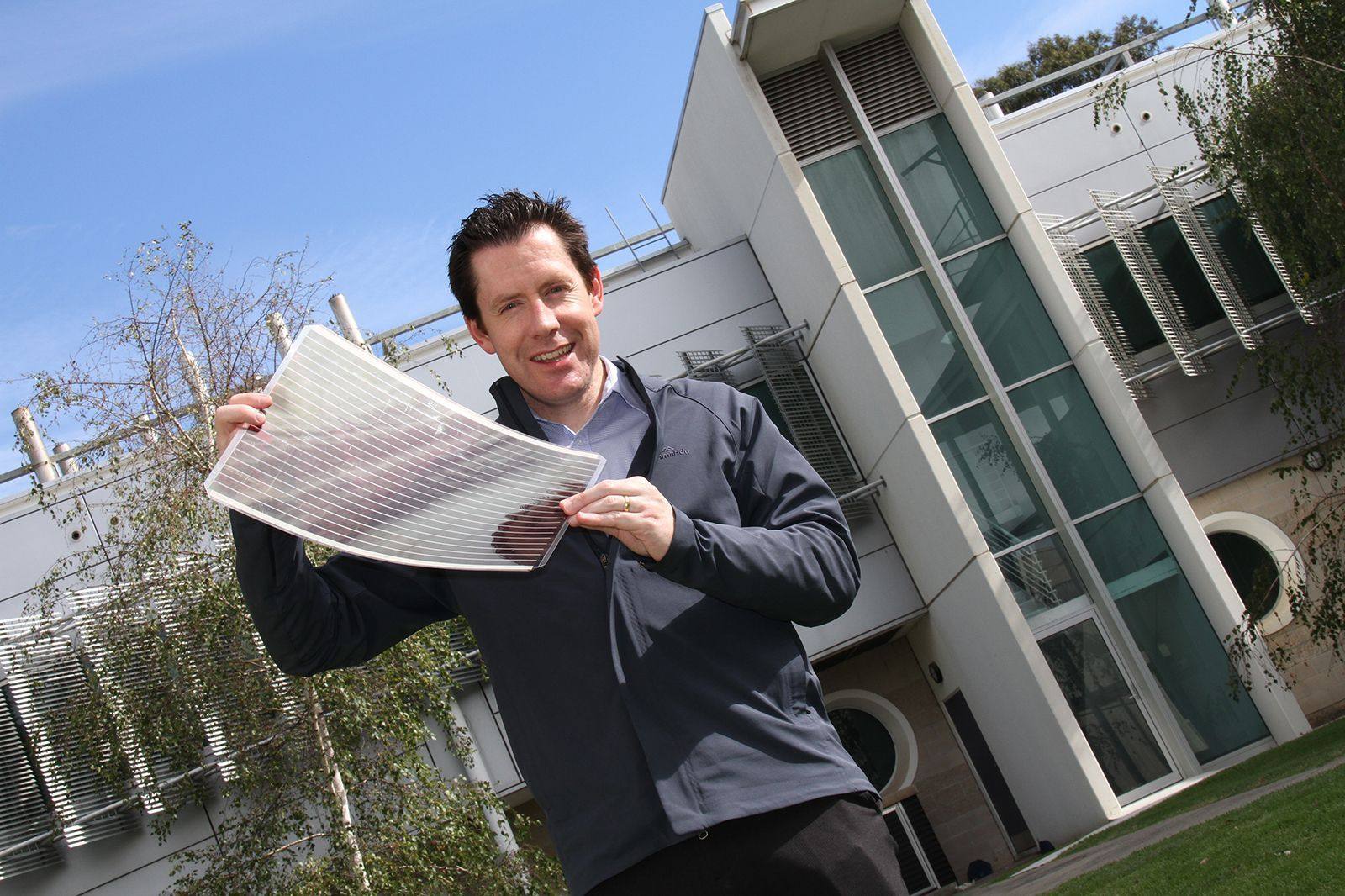
- A Hong Kong–led research team has pushed a single-junction organic solar cell to 21.2% efficiency, independently certified at 20.84%, a new record for the technology.
- The breakthrough, published in Nature Photonics, uses light-emitting “guest” molecules to recycle energy that organic cells normally lose as heat.
- Non-radiative voltage loss fell to 0.142 electronvolts, far below the 0.2–0.3 eV typical of organic photovoltaics, without sacrificing charge generation or transport.
Organic solar cells have spent a decade climbing from single-digit efficiencies toward 20%, and a new organic solar cell efficiency record in 2026 has now carried them past the milestone. A team led by Yingze Zhang and Sai Ho Pun of the Hong Kong University of Science and Technology, with Gang Li of the Hong Kong Polytechnic University, reports a certified power conversion efficiency of 20.84% for a single-junction organic cell, in the paper published in Nature Photonics on 12 October.
The result places this device at the front of the entire organic photovoltaics field. The certified figure matches or exceeds the best values reported for any organic solar architecture to date, and the team recorded 21.2% in its own lab before independent certification.
From heat loss to glow: how the trick works
The bottleneck the team attacked is one of the oldest headaches in organic photovoltaics: non-radiative recombination. When sunlight is absorbed inside the cell, it creates tightly bound electron-hole pairs called excitons. These must reach the interface between the light-absorbing polymer and the electron-accepting molecule to be split into usable charges. At that interface, excitons tend to shed their energy quietly as molecular vibrations, heat, instead of contributing to the voltage the cell can deliver. That lost voltage caps the efficiency.
Rather than redesigning the blend’s nanostructure or retuning molecular energy levels (the two conventional routes), the researchers added a small fraction of a solid-state emissive “guest” acceptor built around a tetraphenylethylene (TPE) core, blended into a host system of Y-series non-fullerene acceptors. The guest’s excited state sits energetically close to the interface’s charge-transfer states, so ordinary room-temperature thermal energy is enough to push an exciton back up onto a bright state. From there, resonance energy transfer hops the excitation onto the emissive guest, which releases it as a photon instead of heat. In effect, the team built a thermally accessible bridge between dark, lossy states and bright, emissive ones, converting a loss channel into light.
Crucially, the twist in the TPE molecule’s shape prevents the tight molecular stacking that normally kills luminescence in solid organic materials. Spectroscopic measurements confirmed the recycled pathway operating, and the guest left the other pillars of device performance intact: charge generation stayed efficient, charge transport was preserved, and the binary host system alone still delivered around 17%.
Molecular dynamics simulations, run with the GROMACS package, mapped the distribution of intermolecular distances and showed the energetic resonance between the charge-transfer and localised states is thermally accessible across realistic molecular configurations, supporting evidence that the glow-recycling pathway is not a laboratory fluke of one particular blend geometry.
And the final performance figure came from combining everything at once: a ternary blend in which the donor polymer, the host acceptor and the emissive guest coexist in a single active layer. Devices built this way reached 21.2% in the team’s own lab before independent certification settled on 20.84%.
20.84% vs. 28.29%: Where the Organic Record Sits Against Silicon
Twenty per cent invites the obvious comparison: crystalline silicon just reached 28.29% with Longi’s hybrid back-contact cell in September 2026, independently verified by Germany’s Institute for Solar Energy Research Hamelin and now sitting at 96.2% of silicon’s theoretical limit. Organic cells will never win a head-to-head on raw efficiency, and that is the wrong contest to judge them by.
The comparison that counts is in the trade-offs. Organic photovoltaics are built from carbon-based semiconductors that can be printed like ink on flexible, lightweight substrates, promising solar foils that roll out like wallpaper, conform to curved surfaces, and integrate into windows and wearables, all without the high-temperature furnaces, heavy glass and aluminium frames that crystalline silicon requires. (See our perovskite-vs-silicon comparison for how the other lab-frontier technology stacks up against silicon.) The value-add here is use cases silicon cannot physically reach.
Measured against its own history, the trajectory is striking: from single-digit efficiencies a decade ago to 20.84% certified today, driven first by non-fullerene acceptors and now by this new photophysical lever. And the 0.142 eV non-radiative voltage loss is the number that matters most to specialists: it shows the new approach attacks a fundamental physics limit rather than squeezing incremental current from better absorbers, meaning it should combine with, not compete against, existing optimisation strategies. If the glow-recycling strategy generalises to other donor-acceptor pairs (still an open question, along with long-term operational stability), the climb toward organic photovoltaics’ theoretical ceiling has a third route forward.
The ratios put the milestone in proportion. At 20.84%, the organic record stands at roughly 74% of Longi’s 28.29% single-junction silicon record cited above, a gap that would have been unthinkable when organic cells languished in single digits.
| Device | Efficiency | Non-radiative voltage loss |
|---|---|---|
| This work, lab result | 21.2% | 0.142 eV |
| This work, independently certified | 20.84% | |
| Binary host system alone | ~17% | 0.2–0.3 eV (typical organic) |
| Longi single-junction silicon record | 28.29% | n/a |
And the 0.142 eV non-radiative loss is roughly 30–50% below the 0.2–0.3 eV typical of organic devices: this is not an incremental absorber tweak but a cut into the technology’s fundamental physics budget. The question that remains, whether the glow-recycling trick survives encapsulation, scale-up and a decade of sunlight, is the same question that has ended every previous organic record’s victory lap. This time, at least, the physics is on the record’s side.
For the silicon baseline behind these comparisons, see our complete guide to how solar panels work. And organic is not the only lab frontier closing on silicon: perovskite-silicon tandems recently pushed past 30.77% efficiency with a self-healing treatment.
Beyond 20.84%: the stability and scale tests ahead
The researchers were candid about the remaining questions. The emissive-guest strategy was demonstrated in one particular host system, and adapting it to other donor-acceptor pairs will require careful energy matching at each interface. Long-term operational stability, the perennial concern for organic photovoltaics, must still be verified for the ternary blends. And since the mechanism relies on thermal repopulation of higher-energy states, researchers will want to check whether the small energetic penalty involved costs anything in photocurrent at different operating temperatures.
Still, the combination of certified efficiency, direct spectroscopic evidence and molecular simulation makes a strong case that solid-state luminescence can be harnessed as a design tool, and the glow, fittingly, is literal.