
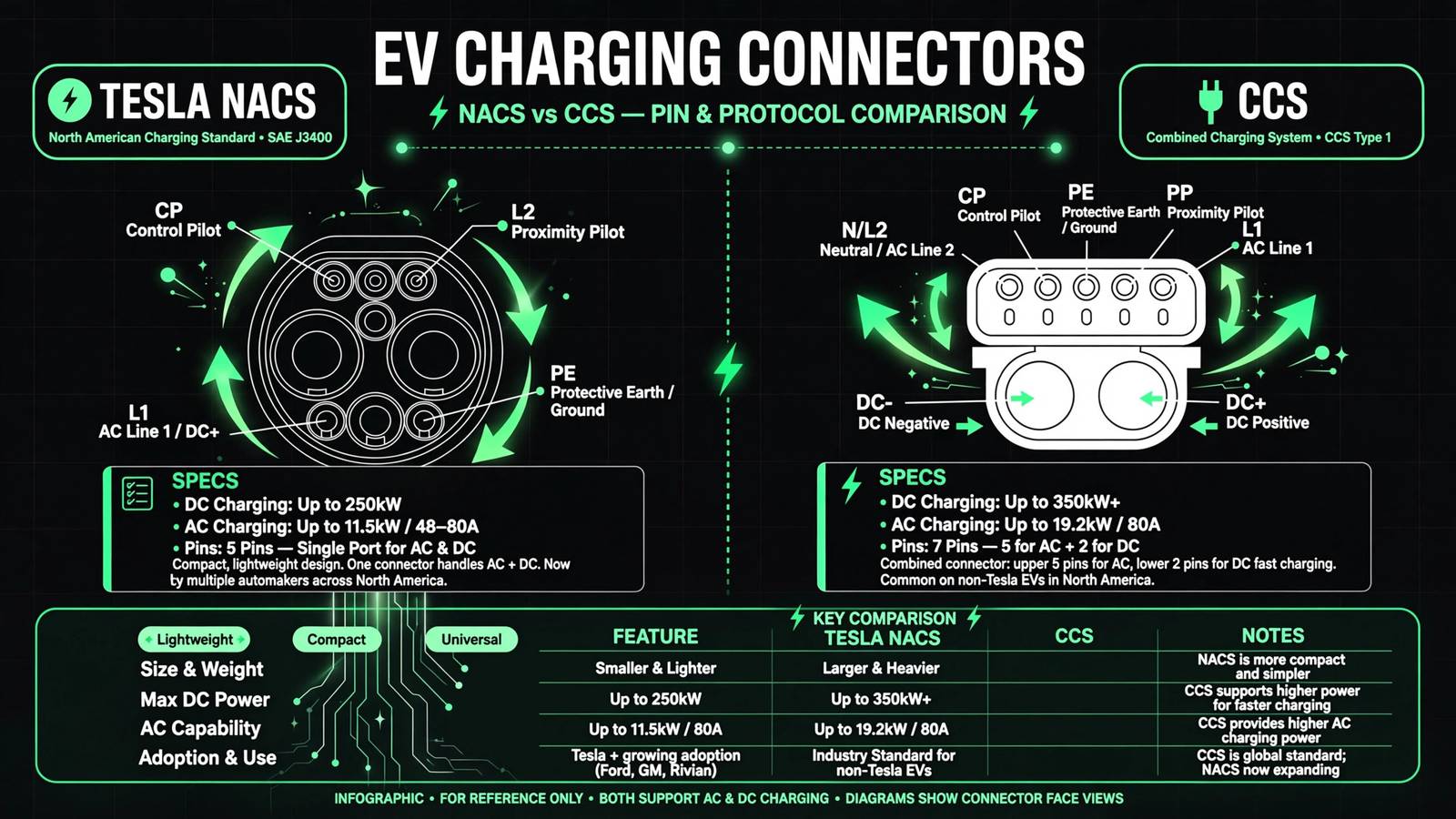
- With automakers switching to NACS, now standardized as SAE J3400, while millions of CCS1 cars stay on the road, North America has two charging connectors and no universal plug. Adapters bridge the gap, but only the right ones.
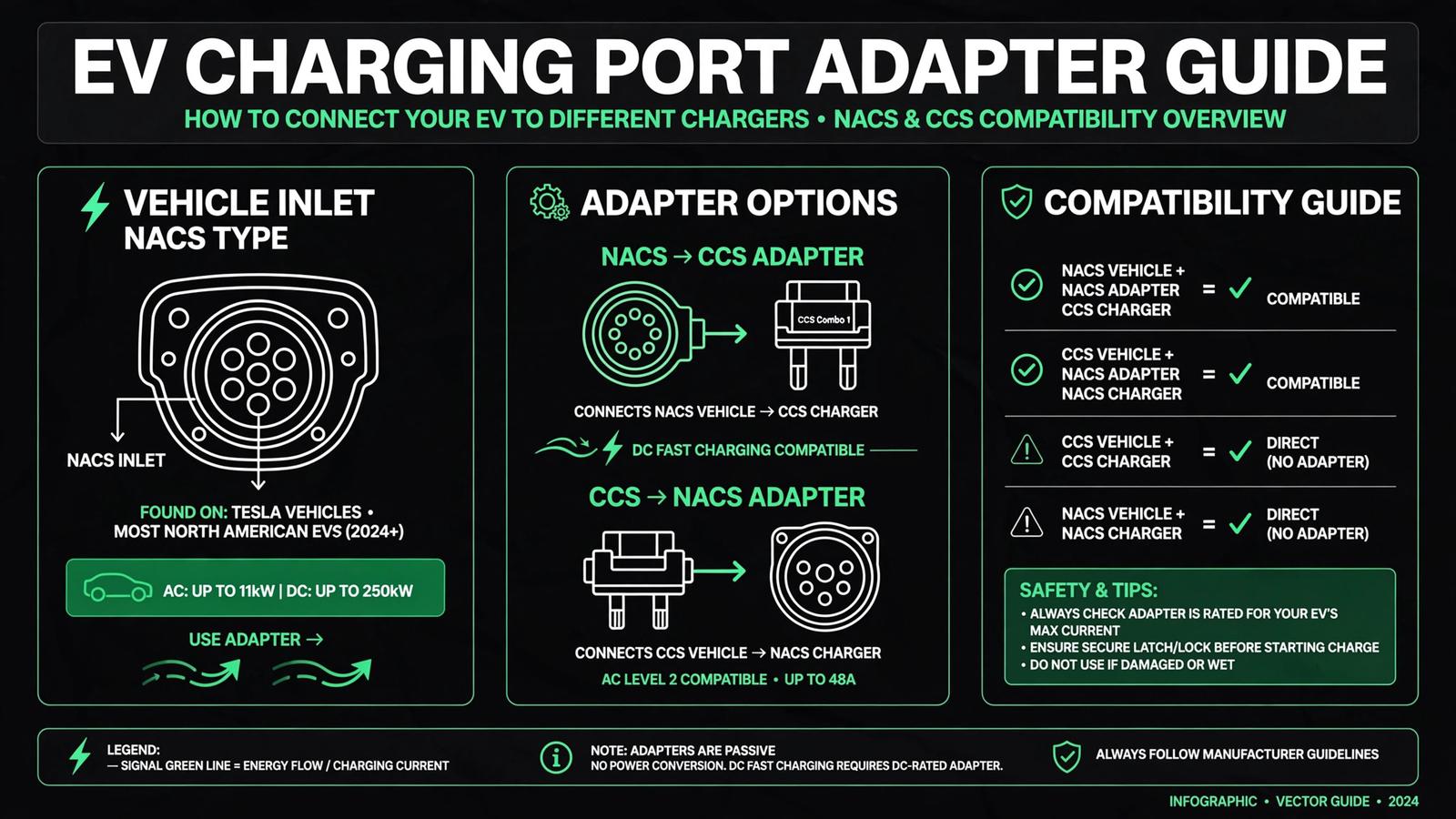
- A CCS1 car needs two different adapters: a NACS-to-CCS1 adapter for DC fast charging at Superchargers, and a NACS-to-J1772 adapter for AC charging at Tesla destination chargers. The plugs look alike; the adapters are not interchangeable.
- Check your actual charge port and owner’s manual instead of assuming by brand and year, since NACS ports were added model by model, and buy manufacturer-approved, UL2252-certified adapters only.
NACS vs CCS: The two EV charging connectors used in North America. NACS (North American Charging Standard, now SAE J3400) is Tesla’s compact single plug handling AC and DC charging; CCS1 (Combined Charging System 1) pairs a J1772 AC port with two DC pins and was standard on most non-Tesla EVs sold through 2024. Adapters let either car use the other network’s chargers.
The question behind every NACS vs CCS charging connector search in 2026 is simpler than the confusion around it: with most automakers switching to Tesla’s plug while millions of older EVs keep the old one, which adapters do you actually need, and which ones are a waste of money? The short answer: it depends entirely on the charge port on your car, and owners keep buying the wrong hardware because the plugs look nearly identical.
The confusion is real. EV owner forums are full of drivers asking whether they need one adapter or two. The answer from experienced owners is always the same: the NACS-to-CCS1 adapter for DC fast charging and the NACS-to-J1772 adapter for AC charging are two different products serving two different purposes. Buy the wrong one and it simply will not work where you need it.
NACS vs CCS charging connector: what the two plugs actually are
The split started in 2012, when Tesla built its own compact connector because no fast-charging standard existed that was small, powerful, and handled AC and DC in one plug. The rest of the industry rallied around CCS, which bolts two large DC pins beneath the familiar J1772 AC plug. The result was an awkward decade: Tesla owners used Superchargers, everyone else used CCS networks, and the two never met.
In November 2022 Tesla opened the connector specification and renamed it NACS. Within about a year, Ford, GM, Rivian, Volvo, Mercedes, Nissan, Honda, Hyundai, Kia and Toyota had all announced adoption, and SAE International fast-tracked it as the J3400 standard. By 2026, nearly every major automaker has committed, and new models like the 2026 Rivian R1S and R1T, 2026 Nissan Leaf, 2026 Cadillac Optiq, 2025 Hyundai Ioniq 5, 2026 Hyundai Ioniq 9 and 2025 Lucid Gravity ship with native NACS ports.
Physically, NACS is roughly half the size of CCS1, uses one set of pins for both AC and DC, and is lighter to handle one-handed. Electrically, though, there is no contest to win: both support the same fundamental power levels, up to 1,000V DC, so there is no speed advantage to either standard at the electrical level. The difference is ergonomics and industry commitment, and, crucially for drivers, which networks each plug unlocks.
The two-adapter rule for CCS1 cars
If your car has a CCS1 port, the vast majority of non-Tesla EVs sold in the US through 2024, InsideEVs’ end-of-2025 adapter guide states the rule plainly: “you’ll need two charging adapters at hand.”
Adapter 1: DC fast charging (NACS-to-CCS1)
To use a Tesla Supercharger (or any DC fast charger with a NACS cable), you need a NACS-to-CCS1 adapter. This is the adapter that matters on road trips: Superchargers are the densest, most reliable fast-charging network in the country, and this is your key to it. If you carry only one adapter, InsideEVs advises, “it should be the NACS to CCS1 dongle.”
Adapter 2: AC destination charging (NACS-to-J1772)
At a hotel, parking garage or workplace with a Tesla Level 2 destination charger, you need a separate NACS-to-J1772 adapter. The trap: “The NACS plugs look the same for both DC and AC chargers, but the charging adapters are different.” The round J1772 section at the top of your CCS1 port handles AC charging. A DC adapter will not do this job, nor will the AC adapter fast-charge. As adapter-buying guides warn, “AC and DC adapters are separate product categories and can’t be used interchangeably.”
| Your car | DC fast charging | AC destination charging |
|---|---|---|
| CCS1 (most non-Tesla EVs through 2024) | NACS-to-CCS1 adapter for Superchargers | NACS-to-J1772 adapter for Tesla destination chargers |
| J1772-only (many PHEVs, older EVs) | Not possible: no DC fast-charge port | NACS-to-J1772 adapter |
| Native NACS (2025+ models) | No adapter at Superchargers; CCS1-to-NACS adapter for older CCS fast chargers | No adapter at Tesla destination chargers; NACS-to-J1772 adapter for J1772 Level 2 stations |
Note the asymmetry that confuses buyers: J1772 and CCS1 share the same top half, so J1772-equipped cars (many plug-in hybrids and older EVs) can use the NACS-to-J1772 adapter for AC charging. But a J1772 port cannot DC fast-charge at all, so these cars can never use Superchargers regardless of adapter.
Check the charge port, not the badge
The single most expensive mistake is assuming your connector from the brand and model year. NACS ports were added model by model during the switchover, so even cars from the same brand and year can have different connectors. The rule is blunt: “NACS ports are added model by model, so even cars from the same brand and year might have different connectors. Always check your owner’s manual or look at your charge port instead of guessing.”
In practice: a 2025 Hyundai Ioniq 5 has a native NACS port, while a 2024 does not. A used-car shopper who assumes “Hyundai = CCS” or “2025 = NACS” will buy the wrong adapter, or the wrong home charger. Pop the charge door and look: one compact port is NACS; a larger port with two big pins below the round section is CCS1. This 30-second check decides everything below, including which home charger hardware to buy in 2026. Units now ship with J1772, NACS, or dual plugs, and matching the car avoids an adapter on every single charge.
99%+ vs 70–85%: Supercharger uptime is the real prize
None of this adapter chore would matter if all networks were equal. They are not. Tesla’s Supercharger network consistently posts 99%+ uptime, while CCS networks historically hovered in the 70–85% range, a gap that is narrowing as Electrify America and EVgo invest in reliability, but one that still makes Superchargers, in the words of the 2026 breakdown, “the gold standard for road trip confidence.” By 2026, about 15,000 of Tesla’s 25,000+ US Supercharger stalls are open to non-Tesla vehicles. The adapters are the price of admission to the reliable half of the network.
| Network | Uptime | Scale |
|---|---|---|
| Tesla Superchargers | 99%+ | ~15,000 of 25,000+ US stalls open to non-Tesla vehicles |
| CCS networks (historical) | 70–85% | 25,000+ CCS stalls nationwide |
| Adapter cost | ~$200 ($175–$250 third-party); buy manufacturer-approved, UL2252-certified units | |
On cost: a quality adapter runs about $200, “a low price to pay for peace of mind,” as InsideEVs puts it, with certified third-party units at $175–$250. Compare that against the failure modes: buying the wrong $200 adapter because the plugs look alike (the single most common owner error), or arriving at a hotel with only a DC adapter and no way to use the destination charger overnight. Buy manufacturer-approved adapters from the automaker’s site or dealer; cheap third-party units are, in InsideEVs’ words, “downright dangerous,” and using an unapproved adapter can void your warranty if something goes wrong during a session. If you cannot get the automaker’s own unit, choose a UL2252-certified third-party adapter from Lectron, A2Z or Amphenol.
There is also a used-car angle most buyers miss. A pre-2025 CCS1 car is not a bad purchase: 25,000+ CCS stalls remain nationwide, automakers ran free or subsidized adapter programs through 2024–2025, and adapters close the rest of the gap. But the port check above should happen before the purchase, not after: knowing the car needs two ~$200 adapters (or that the seller is including them) changes the negotiation. And since charging habits shape battery longevity: heavy DC fast charging roughly doubles degradation versus mostly-AC charging in 22,700-car fleet data, so a CCS1 car you’ll charge at home on AC ages no worse for the connector it carries.
If your new car already has NACS
The adapter logic flips. A native-NACS car uses every Supercharger and Tesla destination charger with no adapter at all. What it needs instead: a CCS1-to-NACS adapter for DC fast charging at older Electrify America and EVgo stalls, and a NACS-to-J1772 adapter for J1772 Level 2 stations. Most automakers include the CCS adapter with new vehicles. Check the trunk before buying one.
One reassurance for everyone: this split is temporary infrastructure, not a format war with a loser. Government-funded public charging stations must support both CCS1 and NACS, networks keep installing dual-cable stalls, and both standards will coexist for the next decade. The adapters are a bridge, not a bet. For the chemistry side of the EV equation, why some new cars pair their NACS port with LFP packs and others with NMC, see our battery chemistry explainer.
Frequently asked questions
What is the difference between NACS and CCS?
NACS (now SAE J3400) is Tesla’s compact single plug that handles AC and DC charging through one set of pins; CCS1 is the bulkier industry plug combining a J1772 AC port with two large DC fast-charging pins. Electrically they support the same power levels: the difference is size, ergonomics, and which charging networks each unlocks natively.
Do I need an adapter for a Tesla Supercharger with a CCS car?
Yes: a NACS-to-CCS1 DC fast charging adapter, preferably the manufacturer-approved unit (many automakers distributed these free or subsidized to existing owners in 2024–2025, so check your owner portal first). A NACS-to-J1772 AC adapter will not work at a Supercharger.
Which EV charging adapter do I need?
It depends on your charge port: CCS1 cars need both a NACS-to-CCS1 adapter (DC fast charging) and a NACS-to-J1772 adapter (AC destination charging); J1772-only cars need only the NACS-to-J1772 adapter and cannot use Superchargers; native-NACS cars need a CCS1-to-NACS adapter only for older CCS fast chargers. When in doubt, check the charge port and owner’s manual, not the brand badge.
Is CCS being phased out?
No. More than 25,000 CCS stalls operate across the US, networks continue building new ones, often with dual NACS/CCS cables, and government-funded stations must support both connectors. New cars are switching to NACS, but CCS infrastructure will serve the millions of existing CCS cars for the next decade.